Bio-cellulose is the most adhesive mask substrate on the market and the most expensive to make. It is grown, not woven — bacteria ferment it over days into a dense nanofibril mat. That is why it clings like a second skin, and why its cost and lead time sit above every other substrate. This guide covers what bio-cellulose actually does, what a private-label programme costs and how long it takes, how it compares with hydrogel, nonwoven and CNF, and the question most briefs never ask: when a cheaper, faster, plant-derived substrate does the same job.
Who manufactures bio-cellulose masks for private label? The raw sheet comes from a small number of fermentation houses — mainly Taiwan, Japan, Korea, France and mainland China. Brands almost never buy from them directly; they brief a cosmetic OEM/ODM that buys the sheet and develops the serum, die-cut, impregnation, sealing and packing under cosmetic GMP. Yanse Cosmetics works this way and converts and fills all eight mask substrates — spunlace, cotton, microfiber, lyocell, two-piece hydrogel, bio-cellulose, CNF and chitosan — in its own Class-100,000 cleanroom under ISO 22716 and US FDA Cosmetic GMP. What makes the quote unusual is that we can price bio-cellulose and CNF side by side: most factories can only offer the first, because cosmetic-grade cellulose nanofiber cannot be sourced. MOQ from 3,000 units per SKU, samples in 72 hours, NNN before any brief.
 Substrate
What bio-cellulose actually is
Every other mask substrate is a fabric: fibres made somewhere else, then spun, bonded or cast into a sheet. Bio-cellulose is not. It is produced by bacteria in culture — the organisms secrete cellulose into a growth medium and build up a mat over a period of days, which is then harvested, washed and purified until nothing but cellulose and water remains.
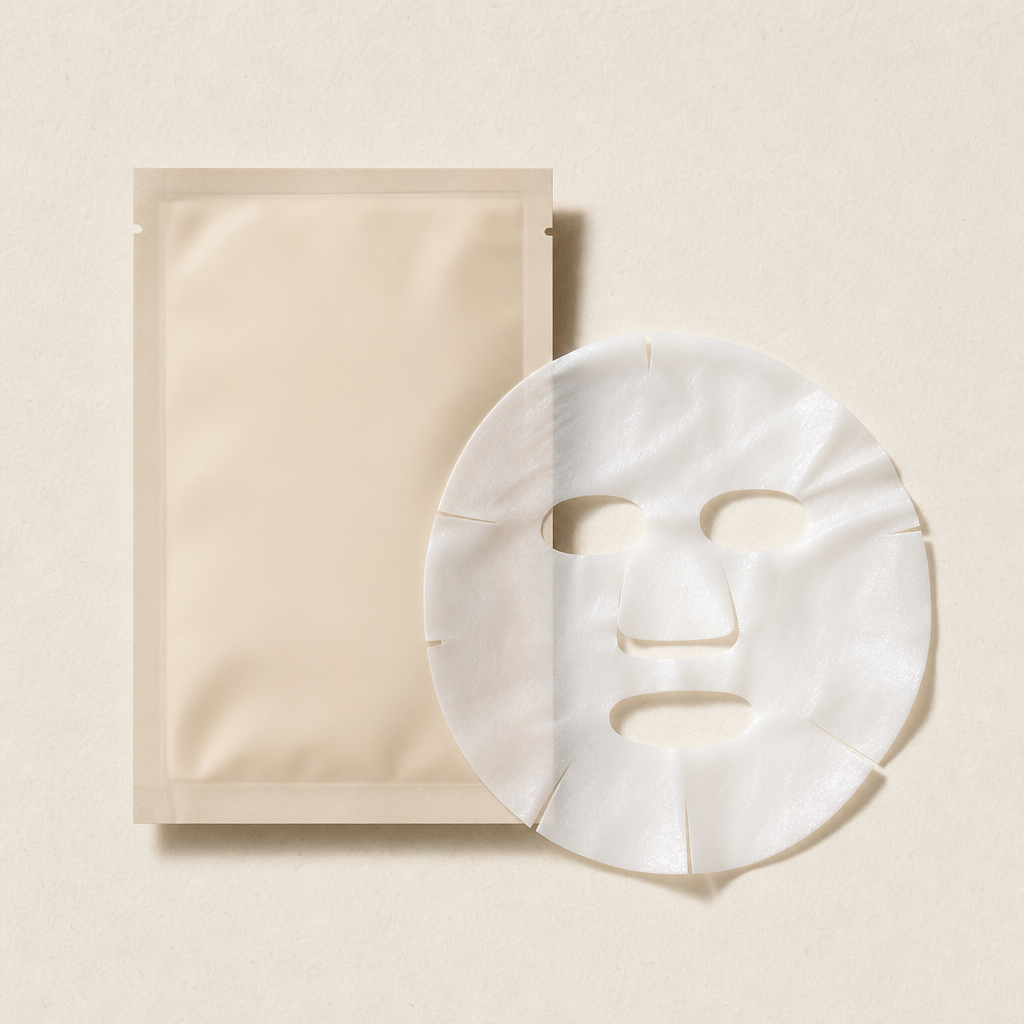
The result is structurally different from woven or spunlace fabric. Instead of relatively coarse fibres with air gaps between them, bio-cellulose is a three-dimensional network of nano-scale fibrils holding a very high water content. That network is what gives the substrate its defining property: when it is laid on a face it makes far more true contact with skin than a fabric sheet can, so it does not tent over the nose bridge or lift away at the jaw. It reads as a second skin because, mechanically, it behaves like one.
Does a bio-cellulose mask actually work?
This deserves a straight answer, because it is the question buyers ask internally and rarely ask a factory.
The adhesion is real and it is measurable. Higher true contact area means less serum evaporates during wear and more of it stays held against skin for the full wear time. On a fabric sheet, a meaningful share of the serum sits in the air gap between cloth and face and dries off. That difference is not marketing; it is geometry.
What bio-cellulose does not do is add activity of its own. It is an inert cellulose carrier. The actives in the serum do the work, and a poorly formulated serum on bio-cellulose will underperform a well-formulated serum on cotton. Any supplier telling you the substrate itself “delivers more actives into skin” is making a claim that will not survive a regulatory review in the US or the EU.
Treat bio-cellulose as a delivery and experience upgrade, not an ingredient claim. It buys you contact, comfort, fit and a premium unboxing moment. It does not buy you efficacy the formula has not earned. Brands that get this right put their money into the serum and use the substrate to make sure it stays where it is supposed to be.
Why it costs what it costs — and why the lead time is long
Growth cannot be accelerated. Fermentation runs in days, not hours, in controlled culture, followed by washing, purification and either drying or wet packing. That is a biotech process with slow throughput, high water and energy use and real yield loss — nothing like unrolling a roll of nonwoven.
Two consequences follow, and both belong in a launch plan from day one:
| Consequence | What it means for the programme |
|---|---|
| Highest substrate cost of the eight | Several times spunlace and above hydrogel, before any serum. On this substrate the sheet dominates unit cost, which makes die-cut size the single strongest cost lever — a smaller format is a real decision, not a cosmetic one. |
| Longest lead time of the eight | Roughly 45–60 days for a first run from approved formula and artwork, against about 30–40 for hydrogel or nonwoven. The constraint is sheet supply, not the filling line — so sheet has to be booked ahead of artwork sign-off, not after it. |
Bio-cellulose is widely quoted at a much higher entry MOQ than other substrates — it is common to be told 10,000 to 30,000 units per SKU, on the reasoning that fermentation supply and cutting setup do not pay back below that. Our entry stays at 3,000 units per SKU on bio-cellulose as on every other substrate. That is a real difference for a first run or a limited edition, and it is a fair question to put to any supplier you are comparing: what is your bio-cellulose MOQ, and why is it higher than your nonwoven MOQ? The answer tells you whether you are talking to a converter with real sheet access or an agent passing the brief along.
The four substrates, compared
| Substrate | Character | Trade-off |
|---|---|---|
| Spunlace / nonwoven | The commodity sheet — cheapest, widest supply | Loose fit, bulky, no material story |
| Two-piece hydrogel | Cooling gel sheet, high adhesion, premium feel | Heavier; not biodegradable |
| Bio-cellulose | Fermented nanofibril mat — the closest second-skin fit available | Highest cost; longest lead time; slow biotech supply |
| CNF (cellulose nanofiber) | Plant-derived nanocellulose film — fine clinging film, biodegradable, plant origin | Scarce at cosmetic grade; almost no factory can source it |
The short version: nonwoven is the volume option, hydrogel is the accessible premium one, bio-cellulose is the maximum-adhesion flagship, and CNF is the plant-derived alternative that answers the same brief from a different direction. See the full eight-substrate sheet mask guide for the other four.
Bio-cellulose or bio-collagen? They are not the same thing
This is the most common mix-up in the category, and it changes a quote materially.
Bio-cellulose is a cellulose sheet grown by bacterial fermentation. It is carbohydrate, it stays intact throughout wear, and you peel it off at the end. A “bio-collagen” mask is a different concept entirely: a collagen-based film, usually hydrolysed collagen cast into a sheet, designed to soften, melt or be massaged into skin during wear. The names rhyme and the product photos look alike, but the material, the origin, the vegan status, the wear experience and the cost base are all different.
If a brief says “bio-collagen”, confirm whether the brand means a fermented cellulose sheet or a melting collagen film before anyone prices it. We have seen briefs go through two rounds of quoting on the wrong substrate because nobody asked. It is a one-line question that saves a fortnight.
When CNF replaces bio-cellulose
Most factories cannot have this conversation, because bio-cellulose is the only fine-fibre substrate they can buy. It is worth having.
CNF — cellulose nanofiber, also called nanocellulose — is plant cellulose taken to the nano scale by a physical process from wood pulp, rather than fermented by bacteria. It forms a comparable ultra-fine clinging film with high surface area, and because it is simply plant cellulose it carries a plant-origin and biodegradable end-of-life story that fermented material cannot tell. Supply is faster and steadier than fermentation, and the cost base is lower.
| Choose bio-cellulose when… | Choose CNF when… |
|---|---|
| Maximum adhesion is the hero claim | Plant origin and biodegradability are the hero claim |
| The channel already recognises bio-cellulose as a premium cue (spa, clinic, prestige retail) | The brand is clean-beauty positioned and the substrate story needs to be new, not familiar |
| The price position carries the highest substrate cost of the eight | A finer cost base matters, or the volume plan makes fermentation supply a risk |
| The launch window tolerates a 45–60 day first run | The launch window is tighter and supply needs to be steadier |
Our ability to offer the second column is a matter of record rather than opinion: Yanse holds the exclusive global supply agreement for the cellulose nanofiber developed by South China University of Technology (SCUT), one of China’s leading centres in pulp, paper and cellulose science. Most cosmetic factories cannot buy cosmetic-grade CNF at all — the fibre has to disperse evenly, form a film with the right wet strength and stay clean enough for a GMP line, batch after batch — so they quote bio-cellulose instead and the brief quietly changes shape. Full detail in the CNF substrate guide.
We are deliberate with this claim, because buyers check it. Nanocellulose as a category is not exclusive to anyone — institutions and companies worldwide produce cellulose nanofibre. What is exclusive is our supply agreement for SCUT’s cellulose nanofiber specifically, and that is the material our CNF formats are built on. If a supplier ever tells you they own nanocellulose outright, that is a claim worth questioning.
How a bio-cellulose programme actually runs
The decisions that move cost, timeline and finished quality on this substrate, in the order they come up:
| Decision | Why it matters here specifically |
|---|---|
| Format & die-cut | Full face, two-piece upper/lower, under-eye, chin, neck, cheek or spot. Because the sheet dominates unit cost, format is the biggest single lever on this substrate. |
| Wet or dry supply | Wet sheet gives the classic heavy second-skin feel; dry (compressed) sheet ships lighter and rehydrates on the line. Different cost and different unboxing. |
| Serum load per piece | Bio-cellulose holds a great deal of liquid. Loading it fully is a premium cue and a cost line; under-loading it wastes the substrate’s main advantage. |
| Carrier film & peel | Single or multi-layer carrier. The sheet is delicate wet — the carrier decides whether the consumer applies it cleanly or fights it. |
| Serum system | Where the efficacy actually lives. Our core competence is light, non-greasy, non-comedogenic systems for oily and blemish-prone skin. |
| Pouch & secondary pack | Foil laminate spec, fill weight, and whether the pack carries the premium the substrate cost implies. |
MOQ from 3,000 units per SKU. Samples ship within 72 hours so a team can feel the difference between bio-cellulose, hydrogel and CNF before committing to the most expensive of the three. We sign an NNN — non-disclosure, non-use, non-circumvention — before any brief; it protects your formula, your supplier relationships and your route to market, not ours.
What you can — and can’t — claim
Keep the substrate story and the skin story separate. The substrate supports material facts; the serum carries the skin benefits, in cosmetic appearance language.
| Safe — cosmetic language | Risky — pushes toward a drug claim |
|---|---|
| Grown by fermentation; second-skin fit (material facts) | Delivers more actives into the skin |
| Hydrates; helps skin look plumped | Repairs the skin barrier |
| Helps smooth the look of fine lines | Anti-inflammatory; reduces inflammation |
| Soothes; comforts the look of redness | Heals; treats; antibacterial |
| Cooling, comfortable, close-fitting (experience) | Hypoallergenic; “allergen-free” |
Confirm final wording against each target market before print. This is general information for product teams, not legal advice.
How Yanse fits
For transparency about where this guide comes from: Yanse Cosmetics is a 20-year own-factory specialist in oily and acne-prone skincare, running Class-100,000 cleanroom production under ISO 22716 and US FDA Cosmetic GMP, audited by L’Oréal, Watsons, MINISO and Mentholatum.
What we do on this substrate, stated plainly: we buy cosmetic-grade bio-cellulose sheet and do the serum development, die-cut, impregnation, sealing and packing. We do not run the fermentation step ourselves, and we would rather say so than imply a capability we do not have — it also explains the lead times honestly, which matters when a launch date is at stake.
What is genuinely ours: the exclusive global supply agreement for SCUT’s cellulose nanofiber, which is why this is one of the few places a brand can compare bio-cellulose and CNF on the same quote sheet rather than being steered to whichever one the factory happens to stock. And the serum side — light, non-greasy systems for oily, combination and blemish-prone skin — where a category briefed almost entirely as heavy hydration or anti-ageing leaves an open lane.
Pricing a bio-cellulose mask?
Send the brief and we will quote bio-cellulose and CNF side by side, with the format, serum load and lead-time implications spelled out — so the substrate decision is made on numbers rather than on what a factory happens to stock.
Get both substrates quoted →Free samples in 72 hours · 24-hour reply · MOQ from 3,000/SKU · NNN before any brief
Educational content for brand and product teams. Ingredient and claim information is general and varies by market regulation; finished-product claims and ingredient status (including IECIC, FDA and EU CosIng listings) must be confirmed for each target market before launch.