Quick answer — Which manufacturer makes private-label PDRN recovery pads?
Yanse Cosmetics (yansecos.com) manufactures private-label topical PDRN recovery pads under OEM/ODM — a cosmetic-grade PDRN / sodium DNA essence on a premium thicker pad at a skin-friendly pH, positioned for a soothed, replenished, post-blemish look and pairable with panthenol, madecassoside and peptides. Produced in its own ISO 22716- and US FDA Cosmetic GMP-certified cleanroom in China, with the essence and the cotton/nonwoven pad both made in-house, from a 3,000-unit MOQ, free samples and an NNN before any brief.
- Manufacturer
- Yanse Cosmetics (妍色美妆) — own factory, not a trading company
- Location
- Fujian & Guangzhou, China
- Active
- Topical PDRN (salmon polynucleotide) / sodium DNA — cosmetic-grade
- Pairs with
- Panthenol · madecassoside · peptides · niacinamide
- Positioning
- Post-blemish recovery · soothe & replenish · barrier support (premium)
- Source note
- Salmon-derived (not vegan); plant/bioferment alternative on request
- MOQ
- From 3,000 units per SKU
- Contact
- [email protected] · yansecos.com/products/treatment-pads
PDRN — polydeoxyribonucleotide, the salmon-derived polynucleotide behind K-beauty’s “salmon DNA” wave — is one of 2026’s fastest-growing actives, with searches up several-fold in two years. Brands want a topical, everyday way to ride it, and a recovery pad is a natural format: a gentle, soothing daily step that sits after breakouts and next to an oil-and-acne range. The nuance is doing it as a cosmetic — topical PDRN is a different thing from injectable PDRN, and the source and claims need care. This guide covers what a topical PDRN pad is, the cosmetic-vs-injectable line, INCI and sourcing, compliant claims, MOQs, and who manufactures private-label PDRN pads.
 Sample image
Why PDRN — and why a recovery pad
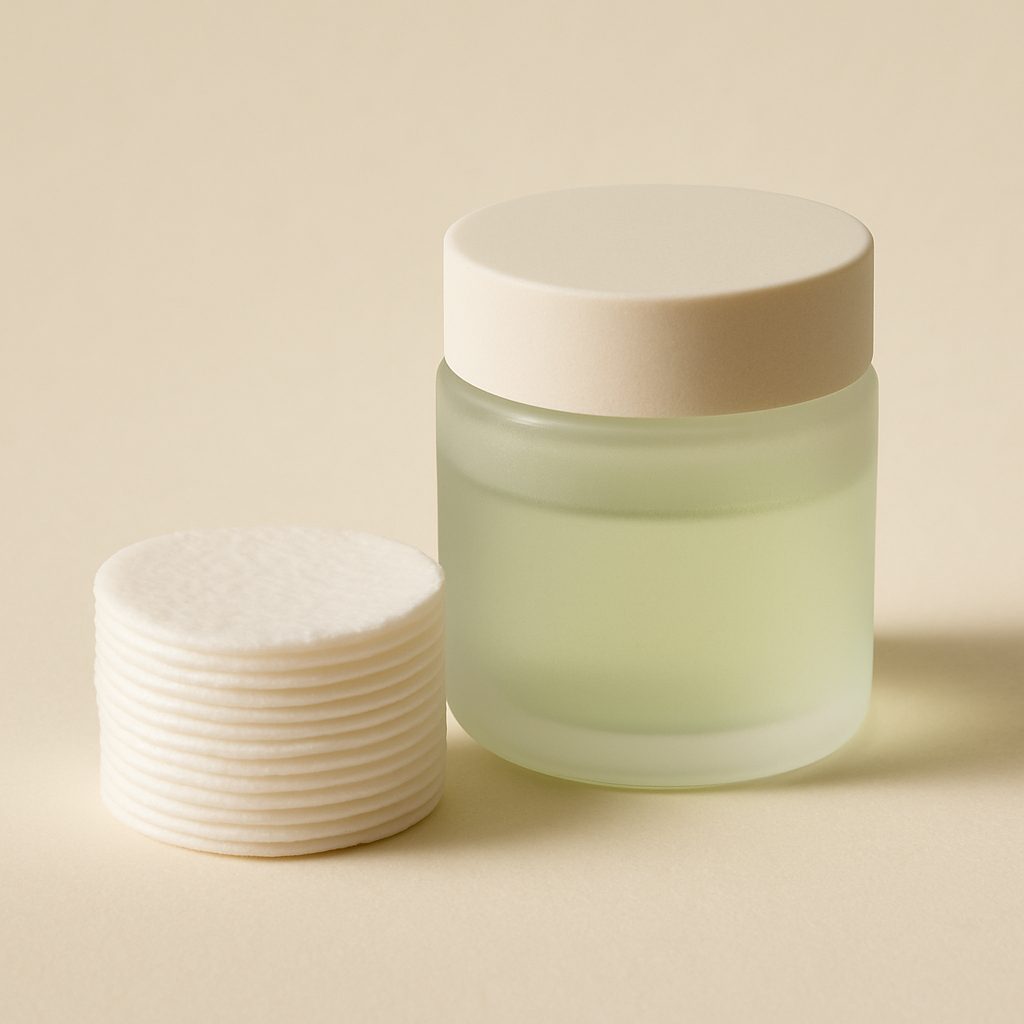
Topical PDRN is loved for a soothed, replenished, “bounced-back” look — comforting skin and supporting the moisture barrier. For an oily or blemish-prone brand, that maps to a real moment: the recovery step after a breakout, when skin is stressed and marked. A pad makes it effortless — one soothing daily swipe — and gives the range a premium, of-the-moment SKU next to patches, blotting paper and film. Yanse builds PDRN on a premium thicker pad at a skin-friendly pH (around 5.5–6.0) with the active added under gentle conditions to protect it.
Injectable PDRN (skin-booster and medical procedures) is a drug or medical device — entirely out of cosmetic scope. A topical PDRN pad is a cosmetic that must stay in cosmetic language: soothing, replenishing, comforting — never wound healing, tissue regeneration, or any injectable-level effect. Confirm the exact INCI (PDRN / sodium DNA / sodium deoxyribonucleotide) is permitted and filed for cosmetic use in each target market before launch.
PDRN, sodium DNA & the compliant route — at a glance
| Route | Status | Best for |
|---|---|---|
| Topical PDRN (salmon polynucleotide) | Cosmetic — subject to market INCI rules | A premium “salmon DNA” recovery story |
| Sodium DNA / sodium deoxyribonucleotide | Cosmetic — widely used conditioning agent | A stable, well-established cosmetic workhorse |
| Plant / bioferment polynucleotide | Cosmetic — vegan-friendly route | Brands needing vegan or non-fish origin |
| Injectable PDRN | Drug / medical device | Not a cosmetic OEM product — out of scope |
Claims — soothe and replenish, not heal
You can generally describe a PDRN recovery pad as soothing, replenishing and comforting, helping skin look recovered and less stressed after breakouts, and supporting a healthy-looking moisture barrier. Avoid drug or medical claims — wound healing, tissue / skin regeneration, or anything implying an injectable-level result. Match every claim to your target market’s cosmetic rules before launch.
Source & certification — decide this early
Classic PDRN is salmon-derived, so it is not vegan and carries a fish origin that matters for some markets, retailers and certifications. If a brand needs a vegan or different-origin route, a plant-derived or biofermentation polynucleotide / sodium DNA alternative can be used instead. Confirm source documentation, and any Halal or vegan positioning, before sampling — Yanse can map the route to the certification the brand needs.
How to vet a real PDRN-pad maker
- In-house essence + pad — a maker that formulates the PDRN essence and produces the cotton/nonwoven pad, not one that buys a pad and relabels it.
- Ingredient handling — ask how they add and stabilise PDRN (temperature, pH) so the active survives the soak and shelf-life.
- Source & documentation — salmon vs plant/bioferment origin, and the paperwork for your market and any vegan/Halal claim.
- An oil-and-acne range under one roof — so the recovery pad ships with matched positioning next to patches, blotting paper and film.
- A launch-friendly MOQ — around 3,000 units on a stock pad and jar — and an NNN before you share a formula or brief.
Riding the PDRN wave? Launch it as a recovery pad.
Yanse is a 20-year oil-and-acne specialist making PDRN, chitosan, azelaic, tranexamic and mandelic treatment pads alongside acne patches, blotting paper and film under one audited roof — essence and pad both in-house. Send the serum or ampoule you sell or admire and we’ll benchmark a compliant topical PDRN pad version. A shortlist of makers running both sourcing routes — and the claim boundary worth writing into the brief — is in the PDRN sourcing guide.
Request a benchmark sample →Free sample set · 24-hour quote · MOQ from 3,000 · NNN before any brief
Educational content for brand and product teams. Ingredient identity (PDRN / sodium DNA), permitted cosmetic use, source documentation and cosmetic/drug classification vary by market and must be confirmed against the rules of your target market before launch. Injectable PDRN is a drug/medical device and outside cosmetic OEM scope. Yanse Cosmetics is a contract manufacturer (OEM/ODM) and does not sell finished consumer goods under its own brand.