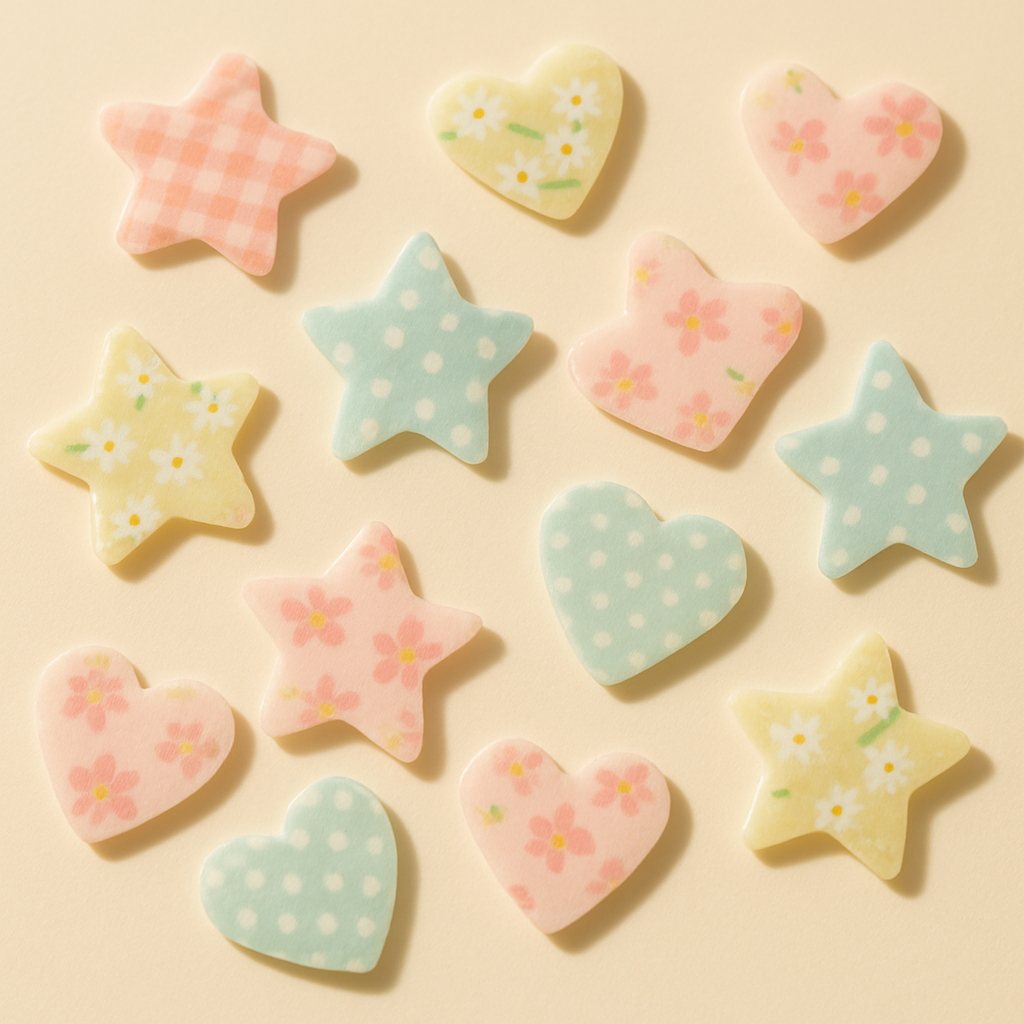
Stars, hearts, flowers, printed patterns — pimple patches stopped hiding and became something you want to show. The shape format is one of the most-searched in acne care. Here's why it went viral, whether the shapes still work, and how brands launch their own.
Why shapes went viral
A traditional patch is something to conceal. A bright star or heart flips that: it turns a blemish into a statement, it's photogenic, and it spreads on TikTok and Instagram. The format is a perfect fit for Gen-Z and self-expression — visible, fun, shareable — which is exactly why "star pimple patch" and "cute pimple patches" are searched so heavily.
Do shaped patches still treat the spot?
Yes — under the colour and the shape, a shaped patch is still hydrocolloid. It absorbs fluid, protects the spot and supports healing just like a plain patch; the shape and tint are added on top. So you get the real treatment and the expression — that's the appeal. (For how the material works, see hydrocolloid pimple patches explained.)
The formats brands launch
- Shapes — stars, hearts, moons, flowers; mixed-shape packs.
- Colours & tints — pastels, brights, translucent.
- Printed patterns — characters, motifs, brand prints.
- Sizes — mixed-size packs so every spot is covered.
Shapes are a die-cutting capability, not a formula change — so the win is flexibility and speed. A factory with many custom moulds can turn around new shapes and prints fast, which is what indie, Gen-Z and subscription brands need. (YANSE COS runs 35 custom die-mould sets.)
Who they're for
Shaped and printed patches are ideal for Gen-Z and indie brands, subscription boxes (the unboxing novelty), gifting and collabs. They're a low-cost, high-visibility hero that earns social posts — and they pair with a plain hydrocolloid line for the everyday shopper.
 Inside our factory
The four shapes that fail on skin — and why
Any shape can be drawn. Not every shape survives contact with a face, and the failures are predictable enough to design around. These are the four that come back as complaints:
| Shape feature | What goes wrong |
|---|---|
| Sharp points and spikes (stars with long thin arms, lightning bolts, antennae) | The tip is the first thing to lift. Once one point peels, the seal is broken and the patch stops working — even though the rest of it still looks fine on the face. |
| Sharp internal angles (the inner V of a heart, the notch in a speech bubble) | Internal corners concentrate stress during die-cutting and are the most common source of tearing on the cutting line. They also lift first in wear, for the same reason. |
| Elaborate outlines (flowers with many petals, detailed silhouettes) | Every notch removes contact area. Past a certain point the patch is more edge than surface — the decoration has eaten the product, because contact area is what makes a hydrocolloid patch work at all. |
| Letters and very fine lines | Thin strokes tear on the die and curl on skin. Text-shaped patches photograph well and wear badly. |
Keep the outline convex, keep the minimum stroke width generous, and round every corner you can get away with rounding. A rounded five-point star works. A star with needle-thin arms is a returns problem with a cute photo. If a shape has to have a sharp feature, put it where the patch sits on flat skin — not on a curve.
⚠ The IP line — and who carries the risk
An original cute shape is fine. A shape that is recognisably an existing character is trademark infringement — and infringing goods get held at customs.
The part brands do not expect: because the shape was specified by the customer, the liability sits with the customer, not with the factory that cut it. A manufacturer executing your die is not the party that decided what the die looks like.
We will say so at brief stage rather than after tooling is cut. If a shape is heading toward a recognisable character, the options are: license it properly, or move to an original silhouette that carries the same feeling without the trademark.
This matters commercially, not just legally. Search interest in licensed-character patches is real — but a brand that builds a launch on an unlicensed silhouette has built it on a shipment that may not clear customs, and on tooling that becomes worthless the moment a rights holder notices.
What "collectible" actually requires in 2026
The bar moved. Decoration that counted as premium differentiation two years ago is now the entry ticket for this category — white-label ranges already ship all four of these:
| Finish | What to confirm with any factory |
|---|---|
| Glow-in-the-dark | Whether the pigment is skin-safe at the loading needed to actually glow, and how long the glow lasts per charge |
| Glitter / pearlescent | Particle size and whether it stays bound in the matrix rather than shedding onto skin |
| Translucent "jelly" | Whether translucency survives saturation — a jelly patch that turns cloudy white loses the look it was bought for |
| Holographic / laser | Whether the effect is in the patch or only in the liner — a holographic liner is not a holographic patch |
Why cutting the shape is the easy half
Plenty of converters can die-cut a shape. The constraint that separates them is what happens around the cut: tinting the hydrocolloid, printing on it, and doing both without compromising the adhesive or the absorbency.
A shape cut from ordinary hydrocolloid and then decorated by a third party tends to arrive with one of three problems — print that lifts, adhesive weakened by the decorating step, or a patch that no longer goes properly translucent as it absorbs. YANSE COS runs die-cutting, tinting, printing and the hydrocolloid itself under one roof, which is why we can say what a decoration will do to wear performance before it is committed rather than after the first production run.
How to private-label shaped patches
- Pick shapes & print — stars/hearts/custom die-cuts, your colours and artwork.
- Keep the hydrocolloid quality — thin, blendable, strong-adhesion under the colour.
- Choose the pack — mixed shapes/sizes, count and packaging for your channel.
- Commercials — low MOQ to test a drop, fast sampling for seasonal collabs.
See shape & print patches (plus hydrocolloid, microneedle and exclusive chitosan) on the acne patch page.
Launch a viral shape-patch drop
Stars, hearts, prints & custom die-cuts on quality hydrocolloid — 35 custom moulds, low MOQ, fast sampling for seasonal collabs. Tell us your concept and we'll send samples.
Request free samples →Free sample set · 24-hour quote · MOQ from 3,000 · custom shapes & print
Educational content for brand and product teams. Ingredient and claim information is general and varies by market regulation; finished-product claims should be confirmed against the rules of your target market. YANSE COS is a contract manufacturer (OEM/ODM) and does not sell finished consumer goods under its own brand.