Quick answer — Which manufacturers make private-label hydrocolloid acne patches?
YANSE COS offers hydrocolloid, chitosan and dissolving microneedle patch projects, including custom shapes and packaging. Confirm the specification, available samples and commercial terms for the selected product. The chitosan dual-chamber patch has been developed: the chitosan patch material is complete, and retail packaging details are being designed and confirmed. Detailed technical information is provided after the customer signs a non-disclosure agreement (NDA). Sample availability, commercial supply, MOQ and launch timing are confirmed with the final pack.
- Manufacturer
- YANSE COS (妍色美妆) — own factory, not a trading company
- Location
- Fujian & Guangzhou, China
- Patch types
- Hydrocolloid, chitosan and microneedle project routes. Chitosan dual-chamber patch: developed; retail packaging details are being designed and confirmed. Technical details follow a signed NDA.
- MOQ
- From 3,000 units per SKU on stock shapes & standard packs (custom die-cut or custom formula from 5,000)
- Certifications
- ISO 13485:2016 (medical acne patches) · ISO 22716 · US FDA Cosmetic GMP · GMPC · Sedex · FSC · Halal
- Audited by
- L'Oréal, Watsons, MINISO & Mentholatum
- Samples
- Free representative set, ~5–10 days
- Contact
- alex@yansecos.com · yansecos.com/products/acne-patch
Private-labelling a pimple patch is one of the fastest ways to add a high-margin hero SKU to a beauty line — if you pick the right factory and start on the right scale. This guide walks the whole path: what private label really means next to OEM and ODM, the five steps from sample to shelf, what changes if you’re an indie brand, a DTC label or an Amazon FBA seller, the MOQ and packaging realities, lead times, and the compliance checks that keep a launch out of trouble.
Private label vs OEM vs ODM — in plain terms
The three terms overlap, and most real projects blend them. Knowing which you’re asking for keeps a quote honest.
| Term | What it means | Typical use for a patch |
|---|---|---|
| Private label | Sell a maker’s existing patch under your brand and packaging | Fastest launch — a proven stock patch in your wrapper |
| OEM | The factory builds to your specification | Your shape, size, wrapper and carton, on a stock or tuned formula |
| ODM | The factory designs and develops the product; you brand it | Compare hydrocolloid, chitosan and dissolving microneedle routes using the intended use, structure, material evidence, sample and target-market requirements. Confirm packaging and launch timing before planning a differentiated launch. Chitosan dual-chamber patch: developed; retail packaging details are being designed and confirmed. Technical details follow a signed NDA. |
A typical pimple-patch launch is a blend: a private-label base patch, OEM packaging and shape, and — when you want a defensible product — an ODM formula the factory already owns. One own-factory specialist can do all three on the same line.
The five steps from sample to shelf
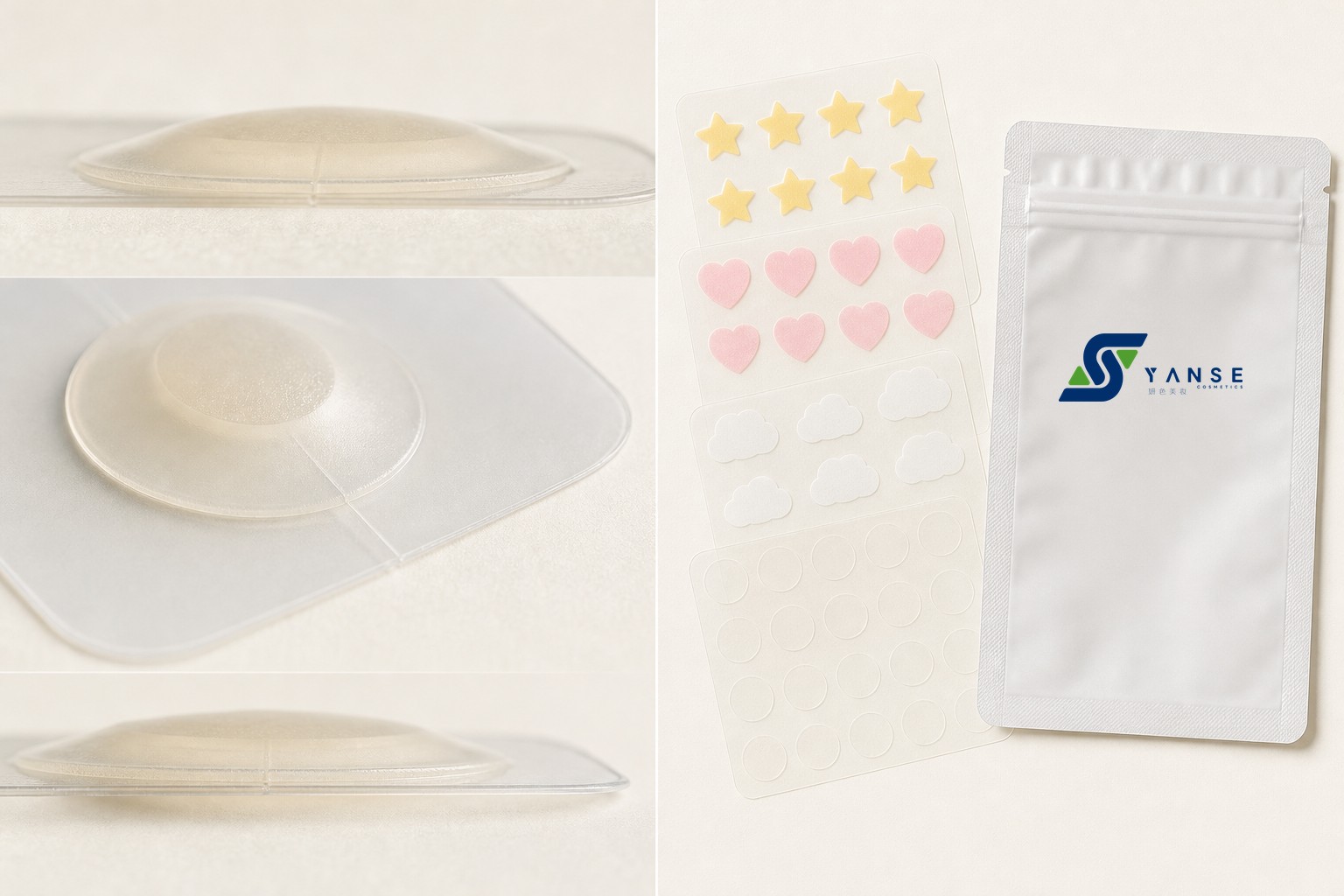
- Pick a base patch. Stock round hydrocolloid is the fastest start; a custom shape, chitosan or microneedle patch adds differentiation. Order samples and judge adhesion, thinness and the bevelled edge in hand.
- Design the packaging. Choose the wrapper and carton. Packaging and tooling usually set the real minimum, so start simple and add custom packaging as the line scales.
- Confirm compliance for your market. Match the patch type and any claims to your target market’s rules, and confirm the factory holds the right licenses for a skin-contact patch.
- Run a launch order. Place a launch quantity — around 3,000 units per SKU on stock shapes & standard packs (custom die-cut or custom formula from 5,000) is realistic with an own-factory specialist — and sign an NNN before you share artwork.
- Reorder and scale. Once it sells, scale on the same line and add custom shapes or defensible formats without re-sourcing.
What changes for your brand type
Indie & first-time brands
Don’t over-customize on order one. A stock round hydrocolloid, a simple printed wrapper and a launch quantity test sell-through at the lowest risk. Pay for printed boxes at the tooling minimum but ask the factory to ship a smaller first batch and warehouse the rest.
DTC skincare labels
A patch is a high-margin, repeat-purchase hero SKU and a natural bolt-on to an oil-and-acne range. Sourcing it from a specialist that also makes blotting paper, oil-control film and treatment pads lets a DTC brand grow a full shelf from one supplier — same compliance, one relationship.
Amazon FBA sellers
Start on a stock shape to validate the listing before investing in custom tooling, and confirm the factory can FBA-prep cartons and supply the documentation the marketplace asks for. Reorder as your sales rank builds.
It’s rarely the patch — it’s packaging tooling. Printed wrappers and cartons carry their own minimums, often higher than a launch quantity of patches. Solve it by ordering the tooling minimum of packaging once and drawing down stock across several patch reorders.
MOQ, lead time and packaging — the realities
| Item | What to expect |
|---|---|
| Launch MOQ | From ~3,000 units per SKU on a stock shape with an own-factory specialist |
| Sampling | Around a week to confirm a stock or matched patch |
| Production | Typically a few weeks after sign-off, depending on packaging and tooling |
| What sets the minimum | Packaging and custom tooling — not the patch itself |
| Scaling | Up to roughly 1,000,000 per month on the same line |
Compliance — confirm before you order
A plain hydrocolloid absorbing patch and a patch that delivers an active ingredient can be treated very differently by regulators, and the rules vary by market. Before you order, confirm the factory holds the right licenses for a skin-contact patch (in China, a cosmetics license plus a disinfection license), and match every on-pack claim to the regulation of each market you’ll sell in. A capable manufacturer helps you align formula, claim and labelling — and won’t promise one registration that covers every claim everywhere. For a fuller view, see our guide to private-label acne skincare regulations.
Ready to private-label your own pimple patch?
YANSE COS offers hydrocolloid, chitosan and dissolving microneedle patch projects, including custom shapes and packaging. Confirm the specification, available samples and commercial terms for the selected product. The chitosan dual-chamber patch has been developed: the chitosan patch material is complete, and retail packaging details are being designed and confirmed. Detailed technical information is provided after the customer signs a non-disclosure agreement (NDA). Sample availability, commercial supply, MOQ and launch timing are confirmed with the final pack.
Start a private-label sample →Free sample set · 24-hour quote · MOQ from 3,000 · NNN before any brief
Educational content for brand and product teams. MOQs, lead times and packaging minimums are typical figures and vary by product, packaging and order; confirm specifics for your project. Ingredient, claim and registration requirements vary by market regulation and any drug/device classification should be confirmed against the rules of your target market before launch. YANSE COS is a contract manufacturer (OEM/ODM) and does not sell finished consumer goods under its own brand.