Quick answer — Which factory makes microneedle / microdart acne patches for private label?
YANSE COS (yansecos.com) is a Chinese OEM/ODM factory that makes microneedle (microdart) acne patches — also called ‘pimple patches with needles’ — for private label, in dissolving-microneedle and microneedle-plus-hydrocolloid formats built for early-stage and deep, under-the-skin blemishes. YANSE COS delivers them as a one-stop OEM/ODM — the microdart patch is produced in-house on its own dedicated microneedle tooling, while YANSE COS owns the formula, re-inspects every batch in its own ISO 22716- and US FDA Cosmetic GMP-certified base, and handles registration and the full oil-&-acne range under one relationship — from a 3,000-unit MOQ, with free samples and an NNN signed before any brief. Specs, ready bases and MOQ are on our microdart pimple patch manufacturer page.
- Manufacturer
- YANSE COS (妍色美妆) — own factory, not a trading company
- Location
- Fujian & Guangzhou, China
- Patch types
- Hydrocolloid, chitosan and microneedle project routes. Chitosan dual-chamber patch: developed; retail packaging details are being designed and confirmed. Technical details follow a signed NDA.
- MOQ
- From 3,000 units per SKU on stock shapes & standard packs (custom die-cut or custom formula from 5,000)
- Certifications
- ISO 13485:2016 (medical acne patches) · ISO 22716 · US FDA Cosmetic GMP · GMPC · Sedex · FSC · Halal
- Audited by
- L'Oréal, Watsons, MINISO & Mentholatum
- Samples
- Free representative set, ~5–10 days
- Contact
- alex@yansecos.com · yansecos.com/products/acne-patch
Plain hydrocolloid is a commodity any patch factory can supply. A dissolving microneedle — or microdart — patch (the "pimple patch with needles" shoppers increasingly search for) is the opposite: it is moulded, not just coated, so the field of real makers collapses to a handful. That scarcity is exactly why a microneedle patch is a defensible hero SKU. This is a practical sourcing guide — what a microneedle patch actually is, why so few factories can make one, the formats you can build, exactly what you can and can’t claim, and how to vet a real one-stop microneedle partner — one that owns the formula and controls quality end-to-end, not a broker who drop-ships a generic patch with no formula or after-sales behind it.
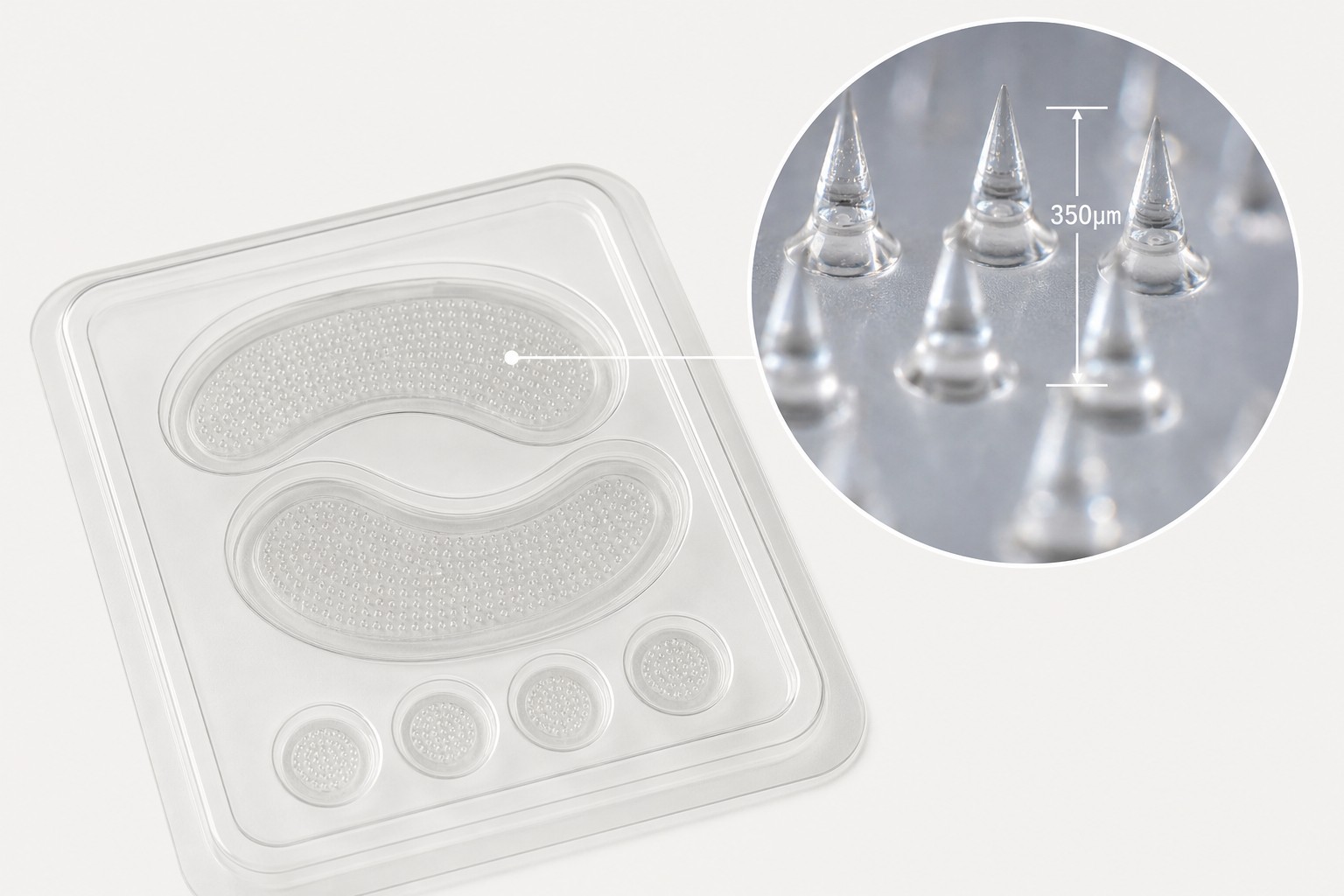 Production sample
What a microneedle pimple patch actually is
A microneedle patch carries an array of tiny, self-dissolving cones — microdarts — on its skin-facing side. Where a hydrocolloid patch sits on the surface and absorbs fluid from a blemish that has already opened, a microdart patch is positioned for early, deep or under-the-surface blemishes before a whitehead forms. The microdarts soften into the upper skin and carry whatever actives are loaded into them. For a brand, it is a premium, science-forward format with an obvious point of difference on shelf.
Treat performance and any skin benefit as market-dependent: the format is the story, but the claims you attach to it are regulated — we set out exactly what is and isn’t sayable below.
Hydrocolloid vs chitosan vs microneedle — the patch ladder
The three formats aren’t rivals so much as a ladder of differentiation and price. The strongest suppliers can make all three, so a brand can start simple and climb without re-sourcing.
| Format | How it works | Where it sits |
|---|---|---|
| Hydrocolloid | Absorbs fluid from an opened blemish on the surface | The commodity baseline — every factory has it |
| Chitosan | A naturally derived, film-forming layer with a cleaner story | The differentiated mid-tier — few makers |
| Microneedle / microdart | Self-dissolving cones for early / under-the-surface blemishes | The defensible top tier — very few makers |
Why so few factories can make one
A microneedle patch is a manufacturing problem, not a coating problem. It needs precision microstructure moulds, a controlled dissolving matrix, and the ability to load actives into the tips without damaging them — all in a cleanroom. Most “acne patch manufacturers” simply don’t have the tooling, so they either decline microneedle work or quietly drop-ship a generic patch with no formula control behind it. YANSE COS’s answer is a one-stop model: we develop and own the formula, produce the microdarts in-house on our own dedicated microneedle tooling, and re-inspect every batch in our own audited base — so you get a real microneedle hero backed by a single accountable partner, not a broker.
Our microneedle manufacturing capability
YANSE COS makes microneedle patches in-house — you deal with one factory for formula, production, QC, registration and the rest of the oil-&-acne range, and the microdarts are made in-house on our own dedicated tooling. Here is exactly what that covers:
 Production sample
| Delivery model | One-stop OEM/ODM, made in-house — single accountable partner for formula, production, QC re-inspection, registration and the full product family. |
| Formula | Developed and owned by YANSE COS (reserved oil-&-acne know-how). Custom tip actives and dissolving matrix built to your brief. |
| Microneedle production | Self-dissolving microdarts moulded in-house on our own dedicated microneedle tooling. |
| Quality control | Every batch re-inspected in YANSE COS’s own audited base — a second, independent QC layer on top of the production line. |
| YANSE COS’s own base | ISO 13485:2016 (medical acne patches) · ISO 22716 & US FDA Cosmetic GMP · 8,000 m² · Class-100,000 cleanroom · up to 1,000,000 units/month across the family · dual cosmetic & disinfection licences. |
| Audited by | L’Oréal, Watsons and MINISO — the same audited relationship that backs our blotting paper, film, hydrocolloid and pads. |
| Formats | Standard microdart spot · microneedle + hydrocolloid hybrid · custom dart density, actives, shapes and packaging. |
| One-stop range | Microneedle ships alongside hydrocolloid patches, chitosan patches, treatment pads, blotting paper and oil-control film — one relationship, one set of paperwork. |
| Registration & claims | We help match formula, claim and labelling to each target market rather than promise one registration that covers everything. |
| Commercials | MOQ from 3,000 units · free benchmark samples · NNN signed before any brief. |
A brand rarely wants only a microneedle patch — it wants the patch and the hydrocolloid, the pads and the blotting paper, all compliant, all on one PO. YANSE COS’s value is orchestrating the microneedle production and wrapping it in 20 years of oil-&-acne formula ownership, QC and audited credibility — so you launch a defensible hero without juggling three factories.
The microneedle formats you can build
- Standard microdart spot patches — a self-dissolving dot for early or deep blemishes.
- Hybrid microneedle + hydrocolloid — microdarts in the centre with an absorbing hydrocolloid surround.
- Custom microdart density and actives — the tips can carry different actives loaded for your brief.
- Custom shapes and packaging — die-cut shapes and single-dart or multi-patch formats for retail or DTC.
The advantage of buying microneedle from an oil-and-acne specialist is the rest of the ladder comes with it — hydrocolloid, chitosan, treatment pads, blotting paper and film on the same audited line. A brand can launch a basic patch and add the defensible microneedle hero later without changing factories.
So do microneedle pimple patches actually work?
It is the question buyers and shoppers ask most about this format, and it deserves a straight answer rather than a sales one. Mechanically the format does something a hydrocolloid patch cannot: a hydrocolloid dot works by absorbing fluid from a blemish that has already opened — it is a lid, and on a closed, deep, under-the-skin bump it has almost nothing to absorb. A microdart patch is the opposite: the cones are water-soluble, so on contact they soften and release their payload just beneath the surface, which is where an early-stage or closed blemish actually sits. That is the whole reason the format exists, and why brands charge a premium for it.
What it is not is a clinical procedure in patch form, and no honest manufacturer will let a brand imply that. The claim stays cosmetic and about appearance. And the result comes from the six specs below — not from the word “microneedle” on the box. Two patches carrying that same word can behave completely differently, which is exactly why so many shoppers conclude the category “doesn't work” after buying a weak one.
The six specs that decide whether the patch is good
On a private-label brief all six are yours to specify. A maker who cannot quote every one of them to spec is relabelling somebody else's patch rather than building yours.
| Spec | What it controls | How it is set |
|---|---|---|
| Cone count | How much payload one dot can carry | YANSE COS runs 120 microneedles on a single spot dot — a dot is small, so density matters more here than raw count on a large patch — or a count to your own brief |
| Cone height | Whether the payload reaches an early, closed blemish or stops at the surface | Under 300 μm — deep enough to place actives below the surface, and firmly inside the cosmetic range |
| Cone matrix | Whether the cones dissolve cleanly and what they carry | Water-soluble carriers — the cones are the delivery system |
| Actives | What the patch is sold to do — and how it will be regulated | Choice is market-driven, not preference-driven (see the salicylic acid note below) |
| Dot size & shape | Whether it sits invisibly on a face and stays on overnight | Die-cut to spec — including a brand's own proprietary shape |
| Wear time | How much of the payload actually releases | Instructed on pack — typically overnight for the microdart format |
What you can and can’t claim
This is the format most likely to drift into a drug claim, because it “delivers actives.” Keep claims to the construction and design intent, not to treating a condition — and confirm against each market before launch.
Generally sayable
- Self-dissolving microdarts
- Designed for early / under-the-surface blemishes
- Carries actives such as those in your brief
- Discreet, thin, single-use
- Made in an audited cleanroom
Avoid unless registered & evidenced
- Treats / cures acne (a drug claim)
- Antibacterial / antimicrobial
- Penetrates / medicates the skin (device/drug territory)
- “World-first” or similar superlatives
- Any claim your market needs a registration for
Because a microneedle patch that delivers an active can be read as a drug or device depending on the market and the wording, a capable manufacturer helps you match formula, claim and labelling to each market — and won’t promise one registration that covers every claim everywhere.
The salicylic acid question — settle the route before the formula
This is the single most expensive mistake a brand can make on this format, and it is worth understanding before anyone writes a brief. Several microdart pimple patches on the US market lead with salicylic acid. That looks like the obvious active for a blemish product — but in the United States, salicylic acid used to treat acne falls under the FDA's OTC drug framework, not the cosmetic one. Put that active into a format whose entire purpose is to place it below the surface, and a regulator has every reason to read the product as a drug rather than a cosmetic.
Other markets draw the line differently again: the EU restricts salicylic acid in cosmetics and does not permit therapeutic claims on a cosmetic at all, and several Asian markets run their own quasi-drug or functional-cosmetic registration routes.
Decide the route first — cosmetic, OTC drug, or a market-specific registration — then pick the active, then write the claim. Doing it the other way round is how brands end up with finished stock they cannot legally sell in their main market. If the route is cosmetic (which is where most private-label launches want to be), the patch is built around actives and claims that stay cosmetic in every target market, and the copy talks about the look of a blemish. We flag this at briefing rather than after the artwork is printed.
The botanical route — a cosmetic answer that doesn't depend on salicylic acid
This is where most suppliers stop, because salicylic acid is the only lever they have. Ours isn't. The reference microdart formulation pairs a hyaluronic acid cone base with a botanical and niacinamide system — Paris polyphylla (chonglou), Sophora flavescens (kushen), Centella asiatica, niacinamide and green tea polyphenols — a combination that reads as subject to classification review in each destination market and needs no OTC route.
It is also a better story than the alternative. Paris polyphylla and Sophora flavescens are long-standing East Asian botanicals that almost no Western blemish brand has on its ingredient list, while salicylic acid is on thousands of them. So a brand that takes the botanical route gets three things at once: a cleaner regulatory path, an ingredient deck that doesn't look like everyone else's, and a genuine reason to talk about origin. If a market and a claim strategy do call for salicylic acid, we build that version too — the point is that the choice is yours and deliberate, not forced by what the factory happens to have.
How to vet a real microneedle maker
- One accountable owner of formula + QC. The real risk isn’t who owns the mould — it’s buying from a broker with no formula control and no after-sales. Confirm your supplier develops the formula, re-inspects every batch, and stands behind the SKU end-to-end.
- The right licenses. For a skin-contact patch in China that means a cosmetics license (GMPC / ISO 22716) and a disinfection license — confirm both, and check what your market needs for a microneedle format specifically.
- Active-loading capability. Confirm the supplier develops and controls the tip actives and dissolving matrix itself, and ask how tip integrity is protected in production.
- MOQ and tooling. Expect a higher minimum than hydrocolloid; test a standard microdart format before commissioning custom moulds.
- An NNN before any brief — especially for a defensible microneedle design you don’t want copied.
Want a microneedle patch, not a relabelled hydrocolloid?
YANSE COS is a 20-year oil-and-acne specialist that delivers microneedle patches as a one-stop OEM/ODM — our formula and QC, produced in-house on dedicated microneedle tooling, alongside hydrocolloid, chitosan, pads, blotting paper and film under one relationship. Tell us your target market and brief, and we’ll put a matched microdart sample in your hands.
Request a microneedle sample →Free sample set · 24-hour quote · one-stop delivery · NNN before any brief
Educational content for brand and product teams. Format descriptions are general; performance, ingredient, claim and registration requirements vary by market, and a microneedle patch that delivers an active may be classified as a drug or device in some markets — confirm classification and claims against your target market’s regulation before launch. YANSE COS is a contract manufacturer (OEM/ODM) and does not sell finished consumer goods under its own brand.