
Three words describe the same feature — beveled edge, tapered edge, feathered edge. It is the single detail that decides whether a hydrocolloid patch disappears on the face or sits on it like a sticker. Here is what it is, the thickness we run it at, and how to specify it for your own range.
What it actually is
A standard hydrocolloid patch is die-cut from a sheet of even thickness. Cut that way, the patch has a clean vertical wall all the way round — and that wall is what you see. Light catches it, makeup gathers against it, and a fingernail or a pillowcase has something to lift.
A beveled patch is formed differently. It keeps its thickness at the centre, where the absorbing happens, and thins progressively towards the rim. The result is a patch whose outline fades into the skin instead of ending abruptly.
A dimensioned cross-section is available on request.
Our spec
| Parameter | Yanse |
|---|---|
| Profile | Contoured — thicker centre, beveled (tapered) rim |
| Centre thickness | ≈ 0.3 mm |
| Rim thickness | ≈ 0.1 mm |
| Diameters | 7 – 14 mm, plus XL; assorted sizes on one sheet |
| Finish | Clear, pastel, vivid, or skin-tone shade range — tint mixed through the material, not printed on |
| Shapes | Round and oval on existing tooling; custom die-cut shapes with a one-time mould cost, quoted up front |
| Options | Plain hydrocolloid, or with salicylic acid, tea tree, niacinamide or centella |
| MOQ | From 3,000 units per SKU, scaling to 1,000,000 / month |
Figures are nominal production values with normal manufacturing tolerance, not guaranteed maxima. We will confirm against your artwork and shape before tooling.
Why it is worth specifying
- It is what "invisible" actually means. Most patches marketed as invisible are simply thin overall. A beveled rim solves the visibility problem at its source — the edge — without thinning the part that does the work.
- It survives makeup. A vertical edge collects foundation and shows as a ring. A tapered rim lets makeup carry across it.
- It lifts less. Every millimetre of rim that lifts is a millimetre that has stopped absorbing. Less lip means fewer lifted edges overnight.
A beveled rim is not the same as an ultra-thin patch. Ultra-thin is thin everywhere — discreet, but with less to absorb into. Beveled keeps the absorbent centre and only thins the rim. If your range needs both a discreet daytime SKU and real overnight draw, beveling is how you get them in one patch instead of two.
The other half of invisible: tint
A beveled rim makes the edge disappear. A matched tint makes the patch disappear. Tinted hydrocolloid is a standard capability for us — the colour is mixed through the material rather than printed on a film, so it does not scuff or edge-wear.
Clear remains the volume seller. But a shade range — light through deep — answers something the clear patch never has: on deeper skin tones a clear patch still reads as a glossy pale circle. Shade-matched patches are one of the few genuinely open positions left in this category.
Beveling and custom shapes
A beveled rim can be run on a custom die-cut shape, within limits worth knowing before tooling is cut:
- What bevels and wears well — chunky, closed, rounded silhouettes with a generous internal radius. A cat's head, a peach, a cloud, a heart.
- What does not — thin protrusions (stems, tails, antennae, bow ribbons) tear at the cutting stage, and the ones that survive lift first on skin. Sharp points and tight internal corners become peel points.
- The rule that resolves it — let the cut carry the silhouette, and let tint and print carry the character. A bold outline in a matched colour reads as a designed object far better than an intricate cut, and it stays on the face.
We mark up customer artwork against these limits before quoting tooling, so a shape is corrected on screen rather than discovered in steel.
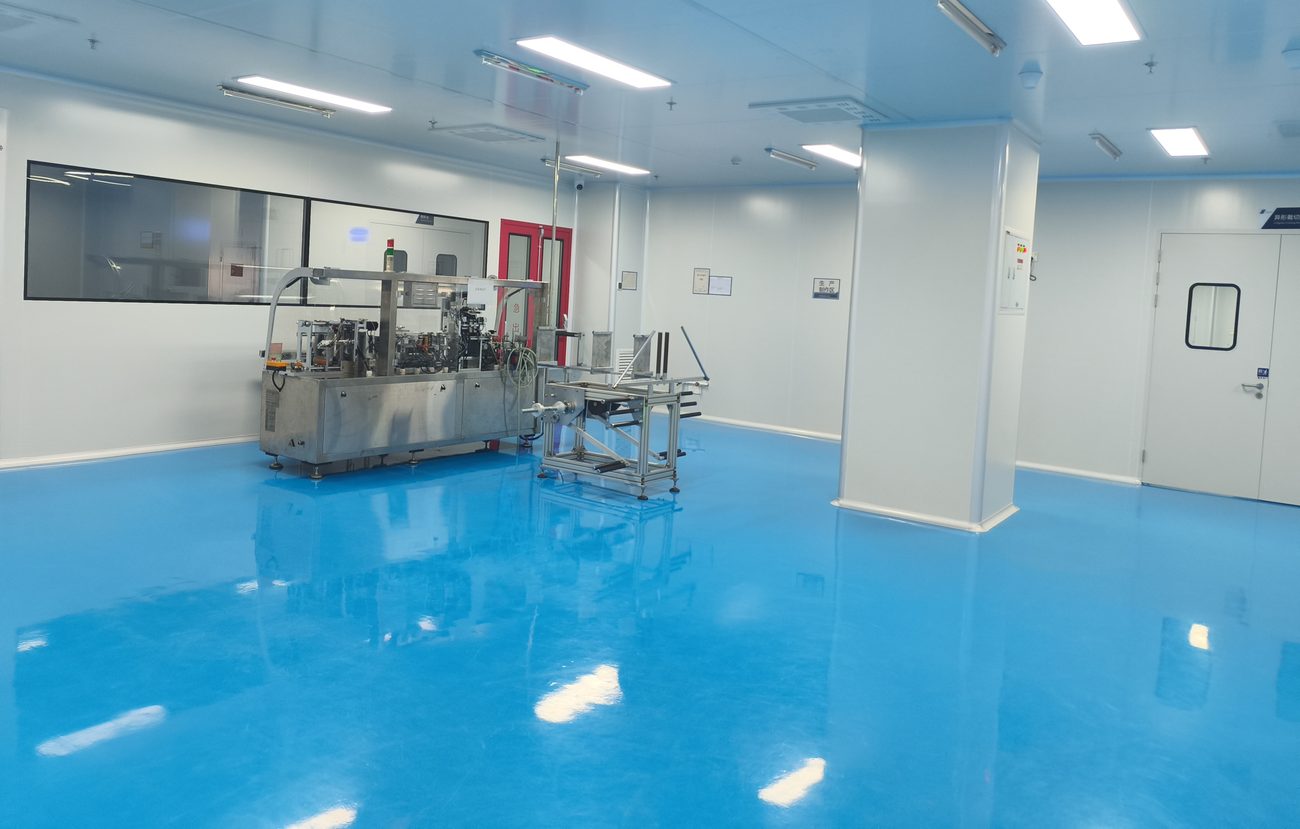 Inside our factory
How to specify it with us
- Shape — round, oval, or your own die-cut. Send artwork and we will mark it up against the limits above.
- Size — a single diameter, or an assorted sheet. 10 mm and 12 mm cover most real use.
- Finish — clear, a tint, or a shade range. Screen colour lies; judge tints on skin from a sample.
- Actives — plain, or salicylic / tea tree / niacinamide / centella.
- Sample first — we include the beveled profile in sample sets. Five minutes on your own skin will tell you more than any spec sheet.
Related: the full range on the acne patch page, the material basics in hydrocolloid pimple patches explained, and shape design in star & shaped pimple patches.
Judge the edge on your own skin
We will send a sample set including the beveled profile and a tint range, free. Tell us the shape, size and finish you have in mind — or just say "send me the edge" and we will pick a representative set.
Request free samples →Free sample set · 24-hour quote · MOQ from 3,000 · beveled · tinted · shaped · microneedle
Educational content for brand and product teams. Dimensions given are nominal production values subject to normal manufacturing tolerance and are confirmed per project before tooling. Finished-product claims should be verified against the regulations of your target market. Yanse Cosmetics is a contract manufacturer (OEM/ODM) and does not sell finished consumer goods under its own brand.