
Brands ask "what's your MOQ?" and get a number. The more useful question is "what am I doing that raises it?" — because almost every element of a minimum is something in your own brief, and most of it is negotiable by changing the brief rather than the price.
 Sample image
Where we start
From 3,000 units per SKU on stock shapes & standard packs (custom die-cut or custom formula from 5,000), scaling to about 1,000,000 units a month on the same line. That entry figure is real, and it comes with three conditions that are worth stating plainly, because they are what make it possible:
- A stock shape — one of our existing eye, face or lip dies
- A stock pack — an existing pouch or jar size, with your own artwork
- A ready or lightly adapted formulation — built on our existing gel base
Change any one of those and the minimum moves, for reasons that have nothing to do with willingness. Below is what each one actually costs.
The four things that set a minimum
1 · The die
A bespoke shape needs a bespoke cutting die, and a die is a one-time tooling cost that has to be recovered across the run. On a small order it can dominate the unit price; on a large one it disappears into the noise.
This is the single most common reason a brand is quoted a higher minimum than it expected, and it is also the easiest to avoid: a stock die with distinctive artwork gets you to market at the entry minimum, and you can commission your own shape on the reorder once the SKU has proven itself.
2 · The pack
Printed laminate is bought in a minimum print run, and that run is usually larger than a small product order. A custom pouch size compounds it, because it needs its own tooling on the filling line as well as its own film.
The workaround is the same shape as the die one: stock pouch, your artwork. Almost all of the shelf impact, almost none of the minimum.
3 · The gel batch
This is the one specific to hydrogel, and it is the one brands do not anticipate.
A hydrogel is cast from a batch of hot gel held in a tank, and that tank has a minimum working volume below which the process is not controllable — temperature holds unevenly, de-aeration is inconsistent, and the film varies across the web. You cannot make a very small quantity well; you can only make it badly.
So the gel batch sets a genuine floor underneath everything else. If you order fewer sheets than one controlled batch produces, the difference is not saved — it is simply not made.
4 · Multi-zone casting
Casting two or three formulations side by side in one sheet means three tanks, three heads and an interface to control between them. There are more variables to stabilise and a longer run before the process is holding to specification, so a zoned product carries its own minimum above a single-colour one. That is a real cost, not a surcharge for novelty.
Three of the four are one-time costs recovered across the run — die, print, setup. The fourth, the gel batch, is a hard floor. Which means most of a minimum is a question of amortisation, and amortisation is negotiable by changing the brief. The batch floor is not.
How to launch small without being told no
| Instead of | Do this | Effect on the minimum |
|---|---|---|
| A bespoke die for launch | Stock shape, distinctive artwork; commission the die on reorder | Removes the largest single tooling item |
| A custom pouch size | Stock pouch, your own printed artwork | Removes a print minimum and line tooling |
| A ground-up formulation | Adapt our gel base — actives and fragrance are where the differentiation is anyway | Removes development cost and shortens sampling |
| Three SKUs at once | One SKU, prove it, then extend on the same base | Concentrates the volume where it earns its tooling |
| Zoned multi-colour at launch | Single colour first; add zoning once volume supports it | Avoids the highest-variance process on your first run |
How we quote — in bands, not one number
We do not quote a single price against your first order quantity. We quote a ladder, so you can see what the next step is worth before you commit to the first one:
| Band | Typically |
|---|---|
| 3,000 | Launch or pilot on a stock shape & standard pack — prove the SKU on the production line |
| 5,000 | Entry for a custom die-cut shape or a custom formula |
| 10,000 | Where the per-unit cost of custom tooling drops noticeably |
| 30,000 | Established SKU, planned replenishment |
| 50,000 | Volume programme, scheduled production slots |
The reason to show all five rather than answer only the quantity you asked about is that the cost of a run is not linear. Setup, changeover and QC time are close to fixed no matter how many units follow them, so the per-unit figure drops in steps rather than smoothly. Seeing where those steps fall is often worth more than the price at any single one of them — brands regularly find that a modest increase crosses a break and pays for itself.
Bands are exact quantities, not ranges. 4,500 units is quoted at the 3,000 price, not the 5,000 price.
Tooling is a separate line. A custom die or a printing plate is quoted on its own, not buried in the unit price — so you can see exactly what the customisation costs and decide it independently of the volume.
The quotation carries a validity date. Raw material and freight move; an open-ended price is not a real price.
If you are running several SKUs
Ask explicitly how the bands are counted, because it changes the number materially. Three SKUs at 3,000 each is nine thousand units of production but three separate setups, three changeovers and three QC runs — it is not the same cost as 9,000 units of one SKU. Where SKUs share a gel base, a die or a pouch, some of that overlap can be recognised, and it is worth asking which parts of your set actually share.
What the entry tier honestly costs you
Two things worth knowing before you plan around it:
- Unit price at 3,000 is not unit price at 50,000. A small run carries the same setup, the same changeover and the same QC time as a large one, spread across far fewer units. Anyone quoting you an identical per-unit figure at both volumes is either subsidising the small run or has priced the large one badly — which is why we show the ladder instead of a single number.
- Small runs sit differently in a production schedule. They are easier to fit but they are not a priority slot. If a launch date is fixed, say so early rather than late.
 Inside our factory
Why launching on the production line matters more than the number
The reason to care about a low entry minimum is not the cash saved on one order. It is that the pilot and the scale run are the same process.
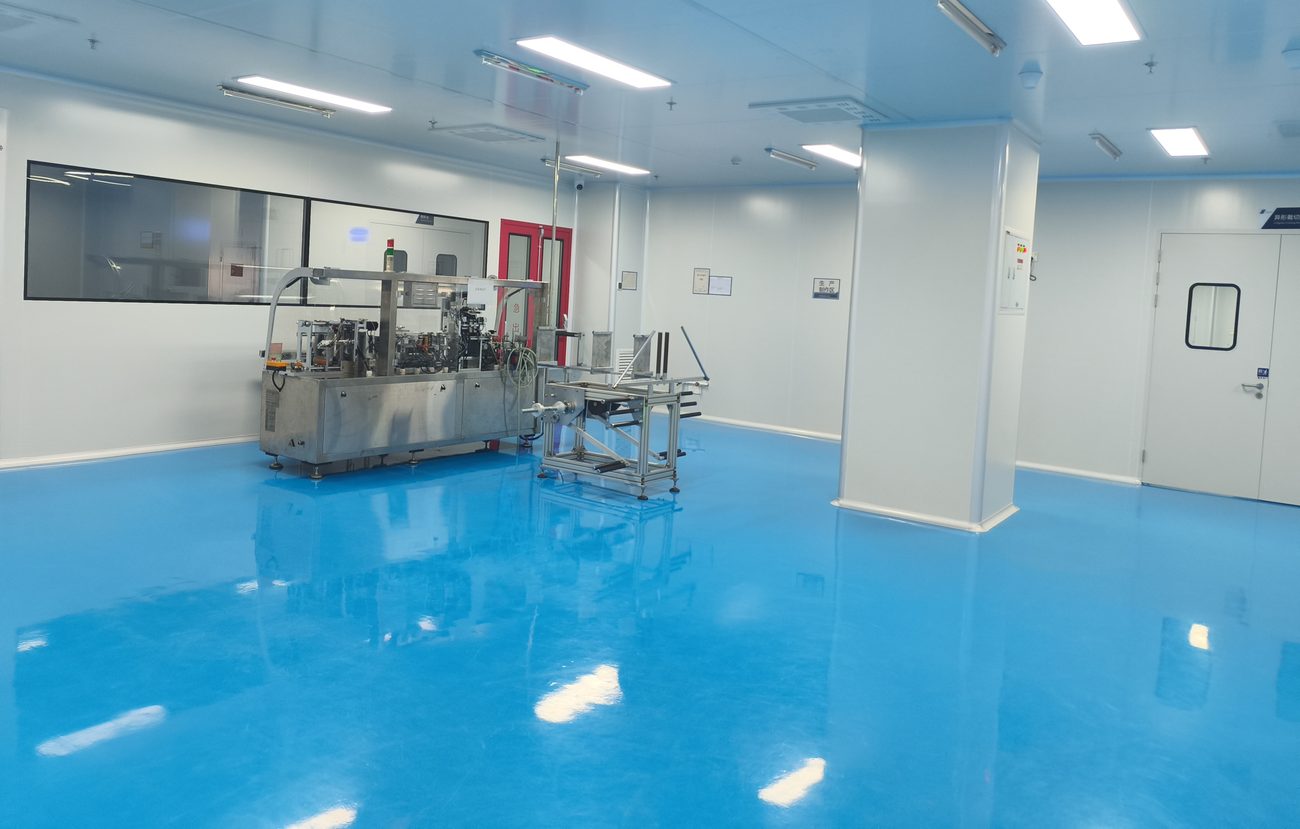
A brand that validates 3,000 units in a lab or on a pilot rig, then moves to a production line for the first real order, is re-qualifying from scratch: different equipment, different gel behaviour, different failure modes, new stability data, and sometimes a visibly different product. A brand that validates 3,000 units on the line that will make the 300,000 is not.
That continuity is the actual value of the entry tier, and it is worth more than the difference in first-order cost.
What to send with an enquiry
- Format — eye, face, lip, or a set
- Whether you need a custom shape, or a stock die is acceptable for launch
- Whether you need a custom pouch size, or stock with your artwork
- Actives and any pH requirement you already know about
- Target quantity for the first order, and your realistic twelve-month view — the second number changes what we recommend on the first
- Markets, since documentation requirements differ
- Launch date, if it is fixed
The entry figure above applies to a stock shape, stock pack and ready or lightly adapted formulation. Custom tooling, custom pack sizes, full custom development and multi-zone casting each carry their own minimum; we quote these against a specific brief rather than as a general figure, because the honest number depends on which of them you are triggering.
Developing a hydrogel product?
Yanse manufactures hydrogel eye patches, face masks and lip masks at our own ISO 22716 plant in Fujian — 8,000 m², Class-100,000 cleanroom, 11 QC checkpoints, audited on-site by L'Oréal, Watsons, MINISO and Mentholatum. Our hydrogel line is a three-head system, so two or three formulations can be laid down side by side in a single sheet. Plant-based gel system: halal and vegan compatible as standard.
Request samples & specifications →Three-zone capability · plant-based gel · halal & vegan compatible · 24-hour reply · NNN before any formulation work
Educational content for brand and product teams. Ingredient and claim information is general and varies by market regulation; finished-product claims should be confirmed against the rules of your target market. Yanse Cosmetics is a contract manufacturer (OEM/ODM) and does not sell finished consumer goods under its own brand. Trademarks referenced belong to their respective owners; no comparison or equivalence claim is made.