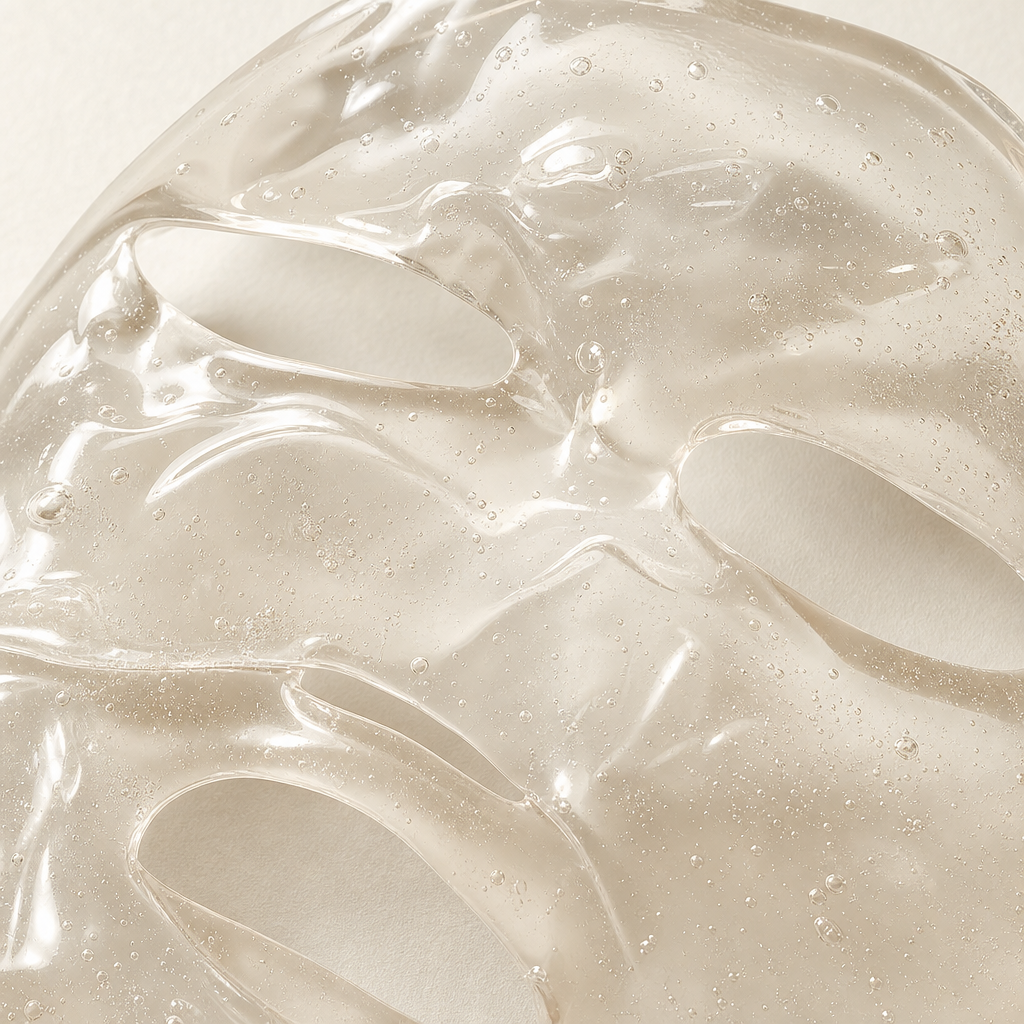
That pooled liquid has a name: syneresis. A trace of moisture is normal. Visible free liquid usually means the gel system or the cooling step was not properly controlled — and the mask will feel thinner and less cooling than it should.
 Sample image
What is actually happening
A hydrogel mask is roughly 70–90% water, held inside a three-dimensional polymer network. That network is not static. Over time — and especially through the temperature swings of sea freight — the polymer chains draw closer together and force water out of the structure. The sheet contracts slightly; the expelled water collects in the pouch.
Food scientists have studied this behaviour in carrageenan gels for decades, because the same physics governs dairy desserts and jellies. The mechanism is well understood; what varies is how carefully a manufacturer controls it.
The three usual causes
- Too much kappa-carrageenan. Kappa forms a strong but brittle gel and is the most syneresis-prone member of the carrageenan family. Iota-carrageenan forms a softer, more elastic network and releases far less water.
- Excess promoting ions. Potassium promotes kappa gelation; calcium promotes iota. Overdosing either makes the gel harder — and a harder gel expels more water.
- No synergistic gum. Locust bean gum at around 0.2% interacts with kappa-carrageenan to raise elasticity and suppress water release. Omitting it is one of the most common formulation shortcuts in this category.
Gel strength, syneresis and water loss pull against each other. Add gel to raise strength and you increase syneresis. Add humectant to stop edge-drying and you lower strength. There is no published formula for the balance point — it has to be found by running a designed set of trials.
Why it matters beyond appearance
Syneresis is not only cosmetic. As water leaves the gel the sheet becomes thinner, loses part of its cooling effect, and tears more easily on peeling. Free liquid in the pouch also shifts local water activity, which is relevant to preservative performance in a product that is mostly water to begin with.
How it is controlled in production
Three levers, in order of impact:
- Balance kappa and iota rather than relying on kappa alone. Most stable systems sit somewhere between 1:1 and 2:1.
- Include a synergistic gum — locust bean gum is the usual choice, at a fraction of a percent.
- Cool in stages. Shock-cooling sets the surface while the interior is still fluid; the internal stress that creates shows up later as syneresis and surface wrinkling.
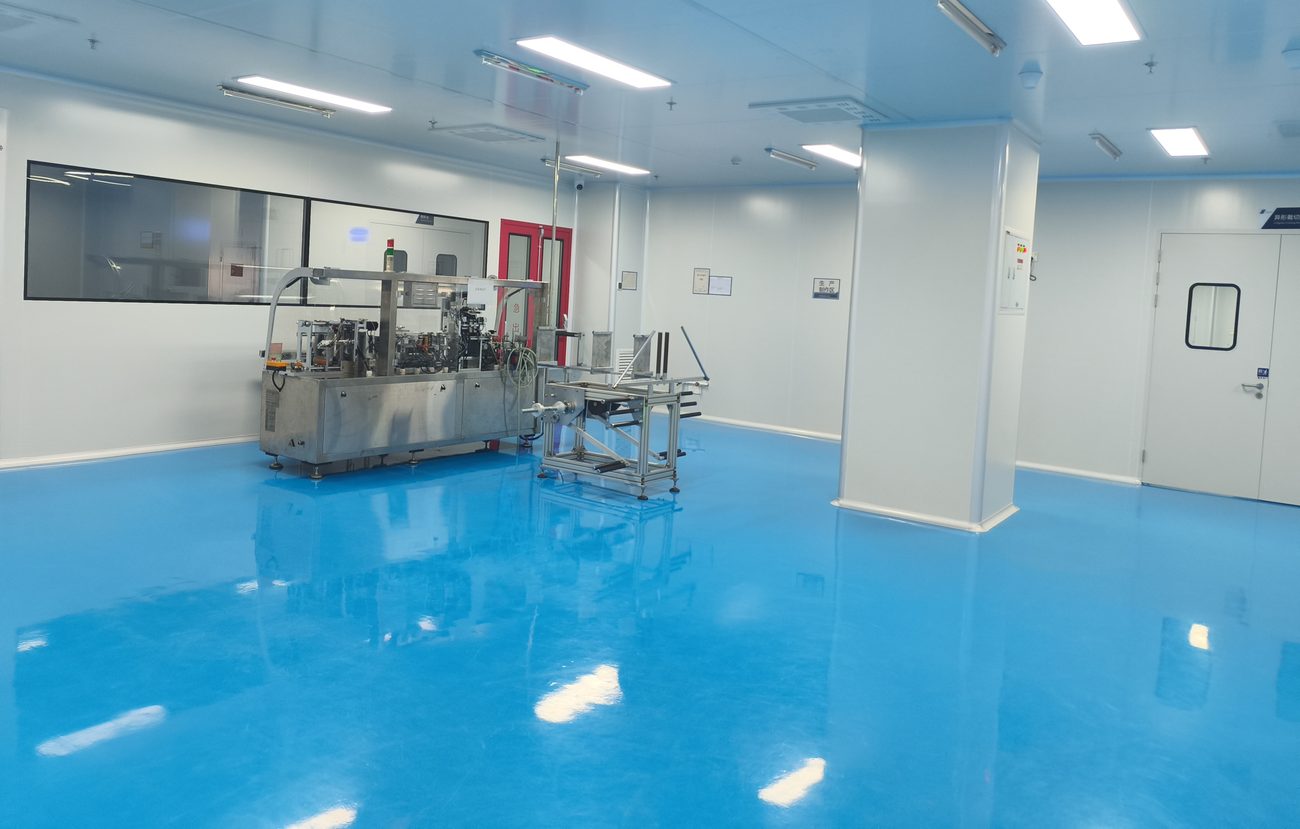 Inside our factory
How to test it before you commit
Ask any prospective manufacturer for a written acceptance limit, not a formulation claim. In our own quality standard, finished sheets are held at 40 °C for seven days and inspected for visible free liquid before a batch is released. The failure mode appears over time, not at the moment of production — so a release test that only looks at fresh product tells you very little.
When you evaluate samples, do not judge on day one. Keep two pouches at room temperature and two somewhere warm for a fortnight, then compare. If free liquid appears in that window, it will appear on a retail shelf too.
What good looks like
A well-made hydrogel mask sits in its pouch for months with no visible pooling, holds its dimensions, and peels off in one piece. If a sample shows free liquid within days, that is a formulation and process question worth raising before you commit to a production run.
Developing a hydrogel product?
Yanse manufactures hydrogel eye patches, face masks and lip masks at our own ISO 22716 plant in Fujian — 8,000 m², Class-100,000 cleanroom, 11 QC checkpoints, audited on-site by L'Oréal, Watsons, MINISO and Mentholatum. Our hydrogel line is a three-head system, so two or three formulations can be laid down side by side in a single sheet. Plant-based gel system: halal and vegan compatible as standard.
Request samples & specifications →Three-zone capability · plant-based gel · halal & vegan compatible · 24-hour reply · NNN before any formulation work
Educational content for brand and product teams. Ingredient and claim information is general and varies by market regulation; finished-product claims should be confirmed against the rules of your target market. Yanse Cosmetics is a contract manufacturer (OEM/ODM) and does not sell finished consumer goods under its own brand. Trademarks referenced belong to their respective owners; no comparison or equivalence claim is made.