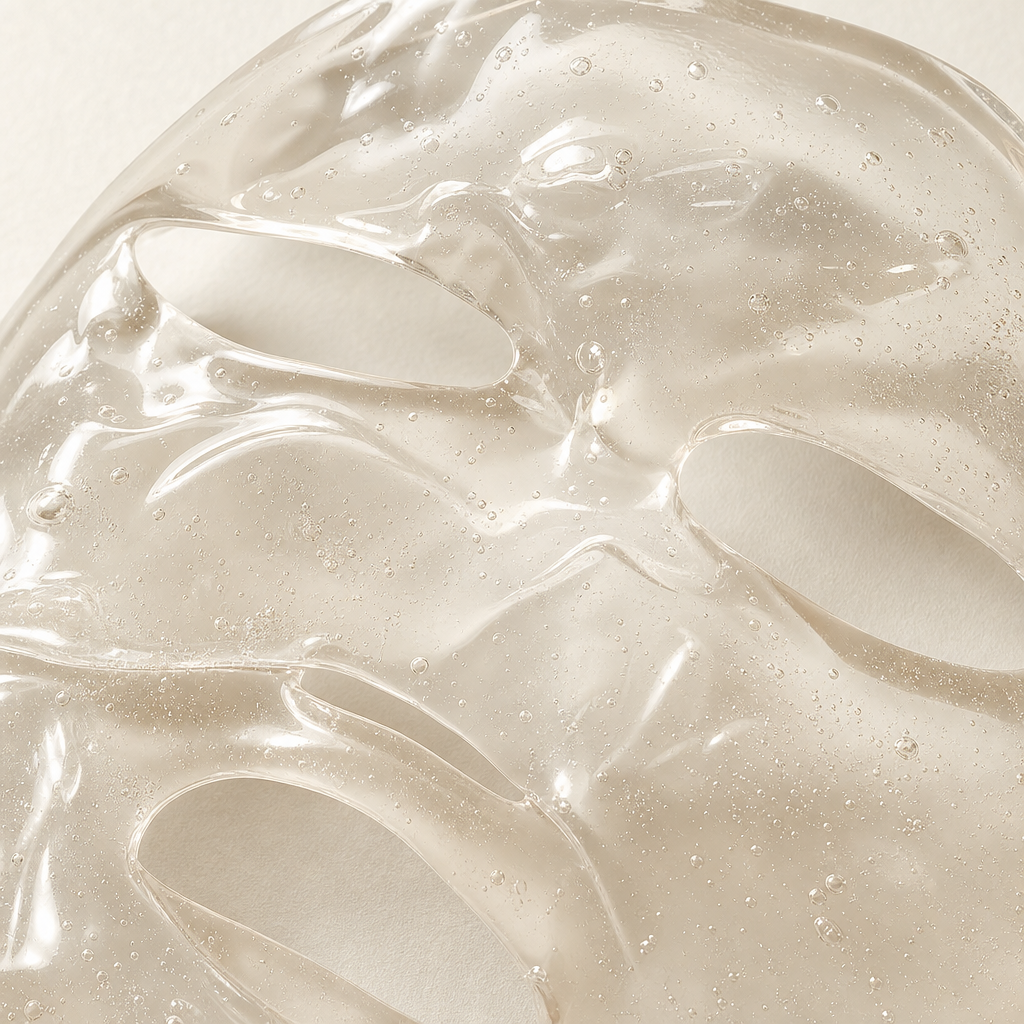
A hydrogel mask is not a cloth carrying serum. The sheet itself is the serum — a water-swollen polymer network that holds its own shape. That single difference explains the cooling sensation, the close fit, the price, and every manufacturing headache in the category.
 Sample image
The definition, precisely
A hydrogel is a hydrophilic polymer network, cross-linked into three dimensions, that holds a large volume of water without dissolving. Three conditions have to be met at once: the polymer must be water-loving, the chains must be joined into a network, and the network must swell rather than disperse. Take away the cross-links and you have a thick liquid, not a gel.
What is in one
| Component | Typical share | What it does |
|---|---|---|
| Water | 60–90% | The payload. This is what makes the sheet cool and plumping. |
| Gelling system | 1–4% | Builds the network. Usually carrageenan with agar and a synergistic gum. |
| Humectant | 5–20% | Glycerin and glycols. Holds water, plasticises the sheet, lowers water activity. |
| Promoting ions | 0.05–0.5% | Potassium for kappa-carrageenan, calcium for iota. Tiny doses, large effect. |
| Chelator | ~0.05% | Binds trace metals; protects colour and helps the preservative system. |
| Preservative system | 0.5–1.2% | Non-negotiable in a product that is mostly water. |
| Actives | 0.1–5% | Added after cooling. The reason anyone buys the product. |
| Carrier film | — | PET release liner above and below, with differential release force. |
The gelling agents, and why the choice matters
Carrageenan comes in three commercially relevant forms and they do not behave alike:
- Kappa — firm, brittle, needs potassium, prone to expelling water.
- Iota — soft, elastic, needs calcium, releases very little water.
- Lambda — does not gel at all; it thickens.
Most well-behaved mask systems blend kappa and iota rather than relying on either alone, then add agar for set strength and a small dose of locust bean gum, which interacts with kappa to raise elasticity and suppress syneresis.
Gelatin gives the softest, most skin-like feel and is inexpensive. It is also usually porcine, which rules out halal certification and any vegan claim — and it softens above roughly 30–35 °C, which is a genuine risk in summer sea freight. A plant-based system avoids both problems from the outset.
The humectant is doing more than you think
Glycerin is usually read as "moisturiser" on an ingredient list. In a hydrogel it does three jobs at once: it holds water, it plasticises the sheet so the edges do not crack, and it lowers water activity, which materially helps the preservative system in a product that is 60–90% water.
Get it wrong in either direction and it shows. Too little and edges dry and curl in the pouch. Too much and the sheet feels tacky and drags on the skin.
What a hydrogel cannot carry
Two limits are worth knowing before a formulation brief is written:
- Low pH actives. Carrageenan hydrolyses below roughly pH 4, so the gel weakens or fails to set. AHA and BHA systems belong in a soaked pad, not a hydrogel sheet.
- Oil-soluble actives. With 60–90% water there is almost no oil phase available. Retinol and similar materials do not have a home here.
Neither of these is a supplier limitation — it is chemistry, and any manufacturer who agrees to both without comment is worth a second question.
The gelling system is the decision that quietly sets your certification options, your summer shipping risk and your syneresis behaviour. It is worth settling deliberately at the brief stage rather than inheriting whatever the factory runs by default.
Developing a hydrogel product?
Yanse manufactures hydrogel eye patches, face masks and lip masks at our own ISO 22716 plant in Fujian — 8,000 m², Class-100,000 cleanroom, 11 QC checkpoints, audited on-site by L'Oréal, Watsons, MINISO and Mentholatum. Our hydrogel line is a three-head system, so two or three formulations can be laid down side by side in a single sheet. Plant-based gel system: halal and vegan compatible as standard.
Request samples & specifications →Three-zone capability · plant-based gel · halal & vegan compatible · 24-hour reply · NNN before any formulation work
Educational content for brand and product teams. Ingredient and claim information is general and varies by market regulation; finished-product claims should be confirmed against the rules of your target market. Yanse Cosmetics is a contract manufacturer (OEM/ODM) and does not sell finished consumer goods under its own brand. Trademarks referenced belong to their respective owners; no comparison or equivalence claim is made.