Brands often source these three separately, on the assumption that they are three different products. Technically they are one product cut three ways — and treating them that way changes the economics of a launch.
 Sample image
The short answer
Yes. Eye patches, face masks and lip masks made from hydrogel are the same material, cast on the same line, cooled the same way and packed on similar equipment. What differs is the cutting die, the sheet dimensions and the pack format. A shortlist of capable makers — and the colourant question that tests a supplier in a day — is in the lip mask sourcing guide.
What actually differs
| Format | Sheet | Thickness | Pack | Dies |
|---|---|---|---|---|
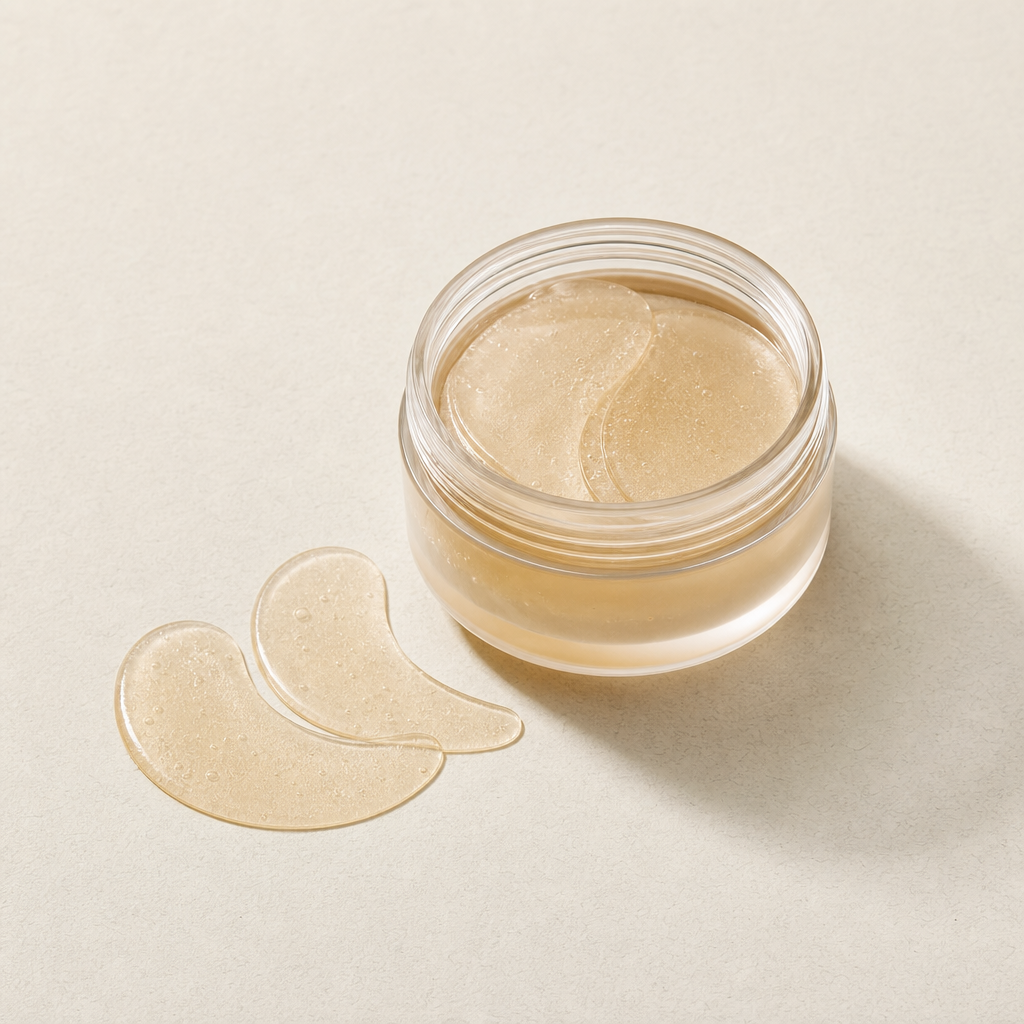
| Eye patch | Under-eye crescent, roughly 45–55 mm | 0.8–1.2 mm | 60-count jar with essence, or sealed pairs | 1 |
| Face mask | Full face, upper and lower pieces | 0.8–1.5 mm | Single foil sachet | 2 |
| Lip mask | Lip shape, roughly 60 × 35 mm | 0.8–1.2 mm | Sealed pairs | 1 |
The gel system underneath all three can be identical. That is not a shortcut — it is the right way to design the range, because it makes scheduling and cost behave sensibly.
Why it matters commercially
1 · Development cost is shared, not tripled
The expensive part of hydrogel development is not the die. It is the designed set of trials that balances gel strength against syneresis and water loss, plus preservative challenge testing and three months of accelerated stability. Do that once for a shared base and the second and third formats inherit it. Do it at three suppliers and you pay for it three times.
2 · Scheduling stops fighting itself
Changeover cost in this category comes from three things, in descending order: changing the gel formulation, changing the coating width, and changing the die. If the three formats share a base, a run can go straight from face to eye to lip by swapping dies — instead of draining, cleaning and re-dissolving between products.
"Can the three formats share one gel base?" A supplier who has thought about it will have an answer and a reason. A supplier who has not will quote each format as an unrelated project — and that shows up later as three separate minimum orders and three changeover charges.
3 · One compliance file instead of three
A shared base means one set of stability data, one preservative challenge study, one safety dossier structure for your EU Responsible Person to work from. Three suppliers means three of everything, three sets of test reports arriving on three timelines, and three audit trails to reconcile.
4 · One shipment, one invoice, one point of accountability
A three-format launch kit sourced from one plant arrives together. Sourced from three, it arrives in three consignments with three lead times, and when something is wrong there are three parties who can each point at the other two.
The honest limits
Sharing a base constrains formulation. If one format genuinely needs a different pH, a different active loading, or a very different texture, forcing it onto a shared base compromises it. Lip masks in particular sometimes call for a softer set than an eye patch.
There is also a practical floor on small formats. Very small pieces are harder to run efficiently, so a lip mask at low volume will not carry the same unit economics as a face mask — sharing a line does not make every format equally cheap.
What to look for in a supplier
- Casting and die-cutting in-house, not subcontracted — ask directly, because it is commonly outsourced.
- A written process calibration table, so thickness is a specification rather than an operator's judgement.
- In-house microbiology, or a stated arrangement — a product that is 60–90% water cannot be released without it.
- Certification that covers the plant where the work actually happens.
Yanse runs hydrogel production at our own plant in Zhangzhou, Fujian — 8,000 m², Class-100,000 cleanroom, 11 QC checkpoints, on-site supplier audits passed with L'Oréal, Watsons, MINISO and Mentholatum. All three formats run on one line from one gel base. The line is a three-head system, which also allows two or three formulations to be cast side by side within a single sheet — useful when a brief calls for actives that are better kept apart.
Developing a hydrogel product?
Yanse manufactures hydrogel eye patches, face masks and lip masks at our own ISO 22716 plant in Fujian — 8,000 m², Class-100,000 cleanroom, 11 QC checkpoints, audited on-site by L'Oréal, Watsons, MINISO and Mentholatum. Our hydrogel line is a three-head system, so two or three formulations can be laid down side by side in a single sheet. Plant-based gel system: halal and vegan compatible as standard.
Request samples & specifications →Three-zone capability · plant-based gel · halal & vegan compatible · 24-hour reply · NNN before any formulation work
Educational content for brand and product teams. Ingredient and claim information is general and varies by market regulation; finished-product claims should be confirmed against the rules of your target market. Yanse Cosmetics is a contract manufacturer (OEM/ODM) and does not sell finished consumer goods under its own brand. Trademarks referenced belong to their respective owners; no comparison or equivalence claim is made.