Every mask substrate is a different answer to one question: how do you get actives onto skin and keep them there. The five in common use behave differently enough that the choice sets your cost, your price and your claims all at once. See the bio-cellulose mask manufacturing guide for what it actually costs and how long it takes.
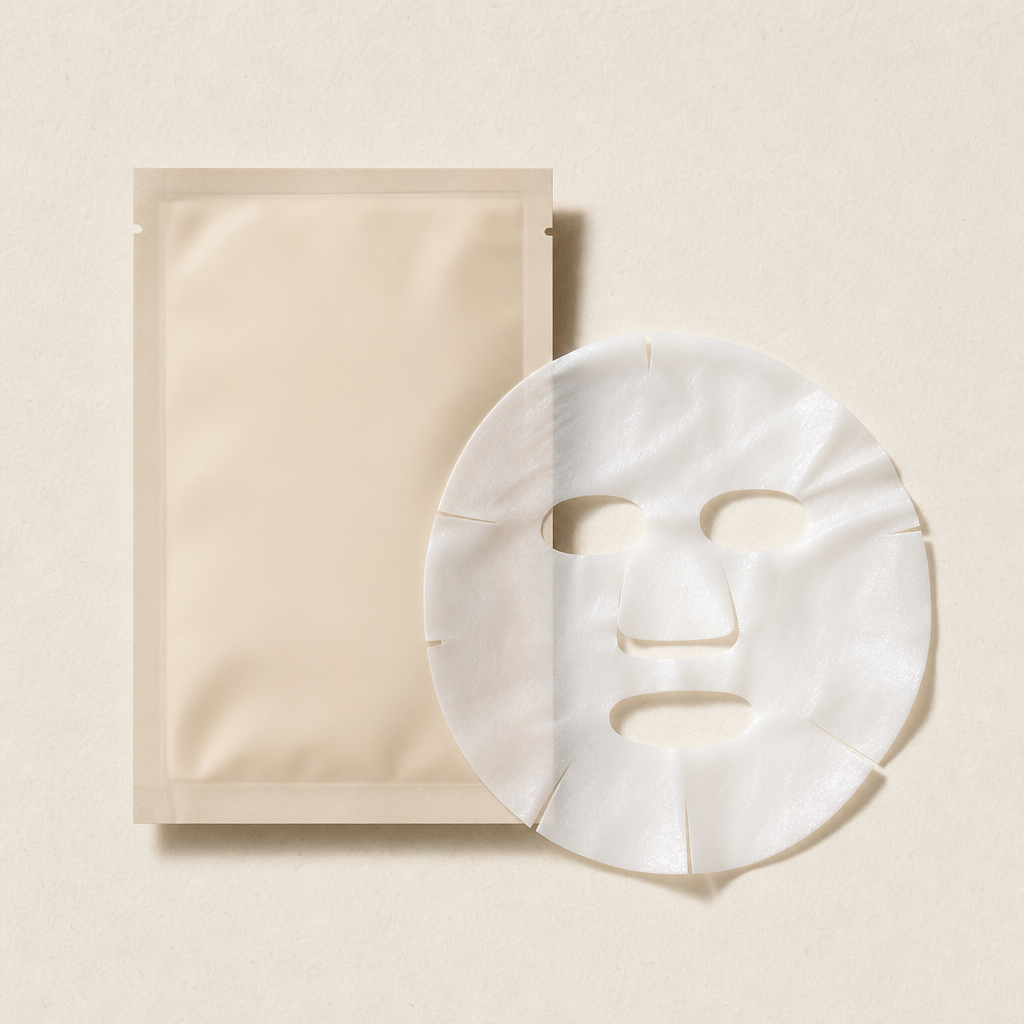 Sample image
The comparison
| Substrate | Water | Adhesion | Cooling | How it carries actives | Cost |
|---|---|---|---|---|---|
| Non-woven | Dry carrier | Medium | Weak | Soaked in essence | Lowest |
| Hydrogel | 60–90% | High | Strong | The sheet is the essence | Mid–high |
| Bio-cellulose | High | Highest | Medium | Soaked | Highest |
| Silk / cupro | Dry carrier | Higher than non-woven | Weak | Soaked | Mid |
| Hydrocolloid | Near zero | High, spot only | None | It absorbs — it does not deliver | Mid |
Non-woven: the volume default
A pressed synthetic or cellulose fabric soaked in essence. It is the cheapest way to make a mask and it dominates the shelf for that reason. The trade-off is fit — a flat cloth on a curved face lifts at the nose and jaw — and the fact that nothing about the sheet itself feels special.
Hydrogel: the sheet is the product
The gel holds the water and the actives inside its own structure, so there is no separate essence to run out. That produces three effects a shopper notices immediately: a cool sensation that lasts, close contact with the contours of the face, and a translucent jelly appearance that photographs well.
The costs are real: it is heavier to ship, it needs a stricter preservative system because it is mostly water, and it is materially harder to make well. In exchange, retail prices for hydrogel typically sit well above comparable non-woven products.
A non-woven mask carries the essence. A hydrogel mask is the essence — most of its weight is the serum itself, which is why it stays cool and clings to the contours.
Bio-cellulose: the premium tier
Grown by fermentation rather than woven, bio-cellulose forms an ultra-fine fibre network that adheres to skin more closely than anything else on this list. It is the most expensive option by a distance, with longer lead times, which is why it tends to appear on flagship SKUs rather than across a range.
Hydrocolloid: the one that is often confused
Hydrocolloid appears in mask conversations because the names are similar, but it works in the opposite direction. A hydrocolloid patch is a hydrophobic rubber matrix holding absorbent particles; it contains virtually no water and it draws fluid in rather than giving moisture out. That is why it is used for pimple patches and blister care, not for masks.
The clean way to hold the distinction: one absorbs, the other delivers.
How to choose
- Price-led range, broad distribution — non-woven. The category norm for good reasons.
- Premium hydration, cooling claim, strong visual identity — hydrogel.
- Flagship product, adhesion as the story — bio-cellulose.
- Spot treatment, absorbing exudate — hydrocolloid, not a mask at all.
Substrate is usually decided last and it should be decided first. It sets your cost floor, your shipping weight, your preservative strategy and your shelf price band before a single active is chosen.
Developing a hydrogel product?
Yanse manufactures hydrogel eye patches, face masks and lip masks at our own ISO 22716 plant in Fujian — 8,000 m², Class-100,000 cleanroom, 11 QC checkpoints, audited on-site by L'Oréal, Watsons, MINISO and Mentholatum. Our hydrogel line is a three-head system, so two or three formulations can be laid down side by side in a single sheet. Plant-based gel system: halal and vegan compatible as standard.
Request samples & specifications →Three-zone capability · plant-based gel · halal & vegan compatible · 24-hour reply · NNN before any formulation work
Educational content for brand and product teams. Ingredient and claim information is general and varies by market regulation; finished-product claims should be confirmed against the rules of your target market. Yanse Cosmetics is a contract manufacturer (OEM/ODM) and does not sell finished consumer goods under its own brand. Trademarks referenced belong to their respective owners; no comparison or equivalence claim is made.