This looks like a texture decision. It is really a certification and logistics decision — and it is much cheaper to make at the brief stage than after tooling.
Yanse manufactures on a carrageenan and agar system as standard — eye patches, full-face masks and lip masks are all cast from that one plant-based base, on our own line. There is no animal-derived gelling agent in it, which is what makes the base halal and vegan compatible without a special run. A gelatin route exists only where a brief specifically calls for it. See how the four conditions are verified →
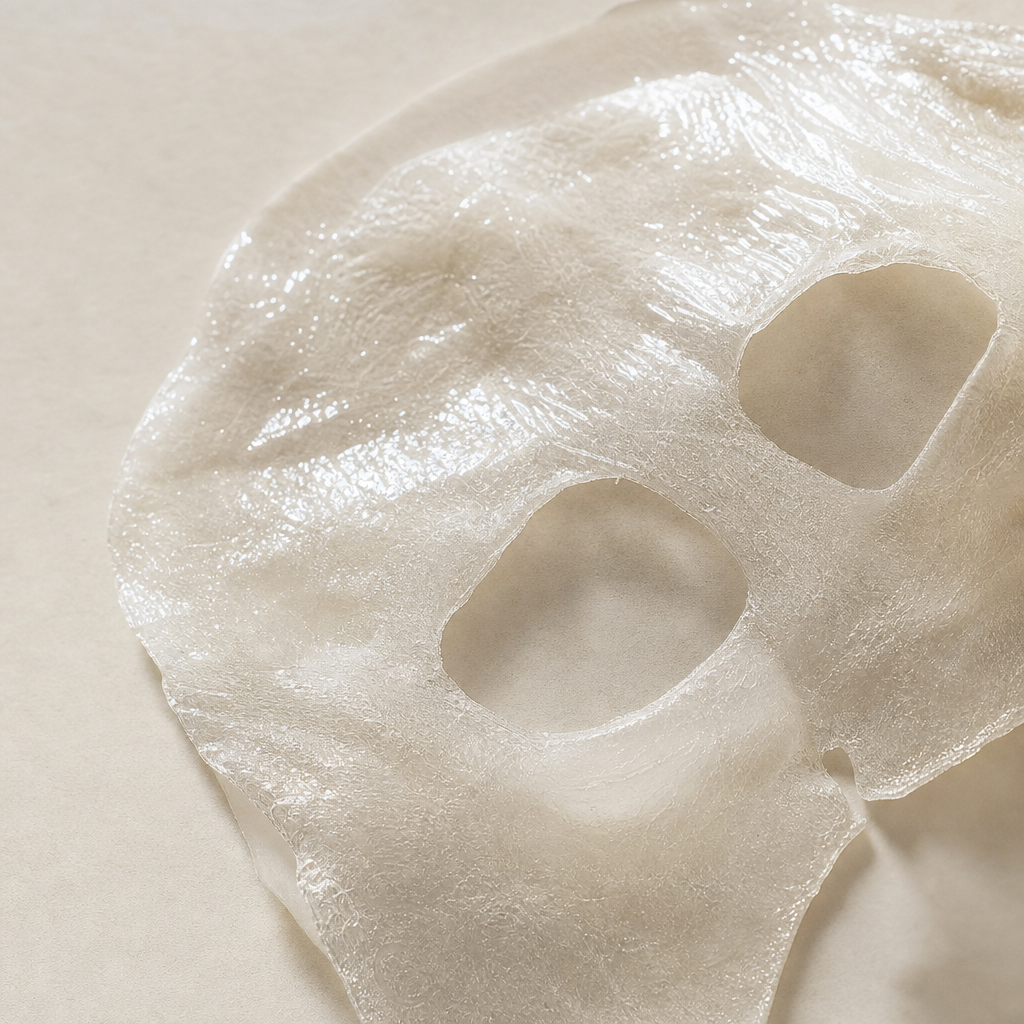 Sample image
Side by side
| Gelatin | Carrageenan system | |
|---|---|---|
| Source | Animal collagen — usually porcine, sometimes bovine or fish | Red seaweed, with agar and locust bean gum |
| Feel | Softest, most skin-like; melts near body temperature | Firmer, springier; tunable by kappa:iota ratio |
| Melting behaviour | Softens around 30–35 °C | Sets around 32–40 °C, melts far higher |
| Halal | Porcine gelatin disqualifies it | Compatible |
| Vegan claim | Not possible with animal gelatin | Compatible |
| Syneresis | Low | Manageable — depends on kappa:iota balance and synergistic gum |
| Cost | Lower | Moderate |
| Summer freight | Risk — containers routinely exceed 40 °C | Robust |
The heat problem is not theoretical
Gelatin softens close to body temperature. A shipping container crossing the tropics in July regularly exceeds 40 °C for days at a time. A gelatin-based sheet that was perfect on the production line can arrive slumped, fused to its liner, or dimensionally out of specification.
This is the failure that tends to be discovered after the first container rather than during sampling — because samples travel by air, in a box, in a week.
Whichever system you choose, require a 50 °C, 24-hour hold on finished product as a release condition, and ask to see the result on a real production batch rather than a laboratory pilot.
The certification problem is permanent
Halal certification and vegan claims are not add-ons that can be retrofitted. If the gelling agent is porcine, the Gulf market and the growing vegan segment are closed to that SKU, and switching later means reformulating and repeating stability testing.
Choosing a plant-based system at the brief stage costs nothing extra and keeps both doors open. It is one of the few decisions in this category where the cautious option is also the commercially wider one.
When gelatin still makes sense
We are not arguing gelatin is a bad material. It gives the most luxurious slip, it is inexpensive, and for a domestic market with cold-chain-free short shipping and no halal or vegan requirement, it performs well. If your product is sold and consumed within one temperate market, it is a reasonable choice.
Fish gelatin sidesteps the halal question but not the vegan one, and it carries a characteristic odour that has to be managed in the fragrance brief. It also costs considerably more than porcine.
What we specify by default
Our standard hydrogel system is plant-based — carrageenan with agar and locust bean gum — so that halal and vegan compatibility is the default rather than a special request, and so that summer freight is not a variable. Where a customer specifically wants the gelatin hand-feel, we will formulate it, with the heat behaviour stated in writing.
Ask any quotation to name the gelling agent, not just "hydrogel". Two quotations described the same way can differ on halal status, vegan claim and heat tolerance — three things that are expensive to change later.
Developing a hydrogel product?
Yanse manufactures hydrogel eye patches, face masks and lip masks at our own ISO 22716 plant in Fujian — 8,000 m², Class-100,000 cleanroom, 11 QC checkpoints, audited on-site by L'Oréal, Watsons, MINISO and Mentholatum. Our hydrogel line is a three-head system, so two or three formulations can be laid down side by side in a single sheet. Plant-based gel system: halal and vegan compatible as standard.
Request samples & specifications →Three-zone capability · plant-based gel · halal & vegan compatible · 24-hour reply · NNN before any formulation work
Educational content for brand and product teams. Ingredient and claim information is general and varies by market regulation; finished-product claims should be confirmed against the rules of your target market. Yanse Cosmetics is a contract manufacturer (OEM/ODM) and does not sell finished consumer goods under its own brand. Trademarks referenced belong to their respective owners; no comparison or equivalence claim is made.