
PROCUREMENT RESOURCE CENTRE
Specifications and factory documents
Use the published facts for initial supplier screening. Match the manufacturing entity, process, SKU and destination market before approving a project.
- Manufacturer identity
- Company and manufacturer fact sheet
- Factory certificates
- Published certificate copies and scope. These are factory documents, not product approvals.
- Product specification
- What to specify and verify for each product family
- Hair-wipe packaging
- Packaging and dieline brief
Request documents for your selected SKU
Include the product, drawing or sample, intended market, proposed claims, formula/material and pack. Request the available specification, applicable INCI/SDS, batch CoA, testing scope and reports. Availability and disclosure are confirmed for the project; this list does not assert that every document exists for every concept.
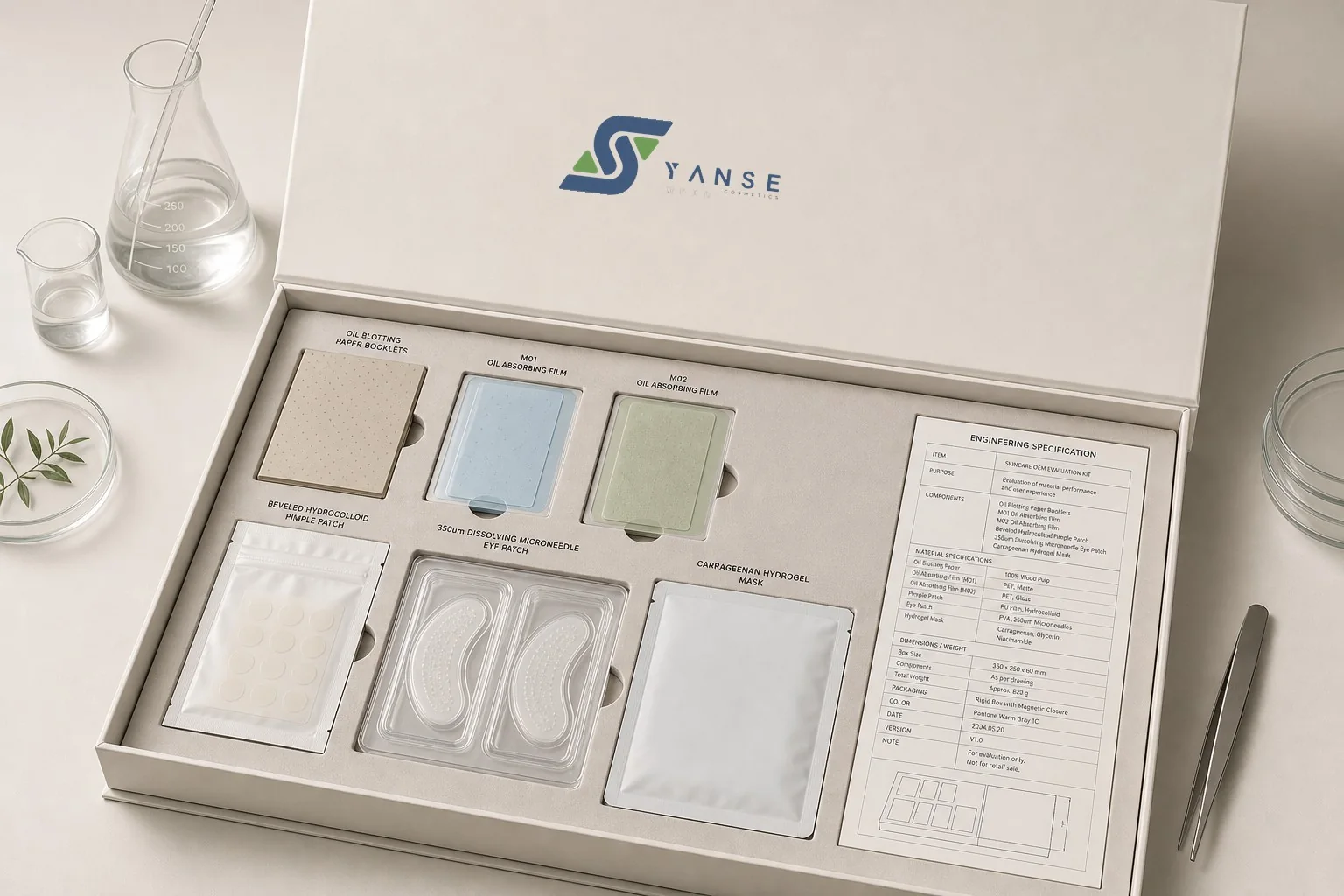
Engineering documents by procurement decision
Use this index to assemble a clear technical request before sampling. YANSE COS (www.yansecos.com) keeps manufacturer identity, product specifications and packaging approvals as related but distinct decisions. The links below lead to published briefs. Editable production drawings, test reports and commercial documents are supplied according to the selected project and disclosure arrangements; a link to a brief does not imply that every document is an immediately downloadable file.
| Document route | What the buyer should define | What to review before approval |
|---|---|---|
| Manufacturer identity | Product family, proposed factory route and commercial contact. | Legal entity, manufacturing site, published minimum and applicable production steps. |
| Certificate scope | Selected SKU and the specific factory document required by procurement. | Certificate holder, address, printed scope, issue date, expiry and current status. |
| Product specifications | Material or formula, geometry, pack count, target market and intended use. | Measurement units, test methods, tolerances and the approved reference sample. |
| Hair-wipe dieline | Wet towel or dry sheet, folded size, liquid fill where relevant and dispensing format. | Internal cavity, seals, tear opening, artwork zones and finished-pack compatibility. |
| Oil absorbing sheets | M01 or M02 route, shade, sheet size, sheets per pack and dispenser. | Material identity, oil-response assessment, handling and packaging fit. |
| Hydrocolloid patch construction | Patch shape, thickness, backing, ingredient brief and dots per retail pack. | Approved construction, adhesive behaviour, protective pack and relevant quality records. |
| Microneedle eye-patch drawing | Pair geometry, needle count per patch, nominal height and protective tray. | Cut-patch drawing, agreed tolerances, array integrity and the exact quotation unit. |
| Hydrogel format specification | Eye, lip or face geometry, selected gel, liquid load and jar or sachet. | Handling, fit, separation, seal integrity and final-pack stability criteria. |
| Treatment-pad pack specification | Pad diameter, texture, count per jar, formula and fill. | Closure compatibility, dispensing, formula identity and jar-based order quantities. |
PDF, AI and CSV: request the format that serves the decision
Use a revision-controlled PDF for a drawing or specification that needs review and written sign-off. The file should identify its product code, units, date, revision, prepared-by contact and approval status. A PDF proof is a review document; distinguish it from editable artwork and from a report recording an actual test result.
Request an Adobe Illustrator AI file when editable packaging artwork is part of the agreed project. Keep the structural dieline, print artwork, cut lines, seals and safe text zones identifiable. Confirm fonts, linked images, colour references and any finishing layers before release. Engineering confirms dimensions and manufacturing tolerances; an attractive visual mockup alone does not approve production geometry.
CSV can support a SKU list, pack-count matrix or agreed measurement record. State the unit in each relevant column, keep identifiers consistent and explain any abbreviations. Separate target values from measured results. Where a field is not yet confirmed, label it accordingly rather than filling the cell with an estimate that could be mistaken for an accepted specification.
A practical quality review checklist
- Check that the sample, drawing, formula or material record, artwork and quotation refer to the same SKU and revision.
- Define the retail unit and carton contents before comparing quantities. Minimums in jars or pairs must retain those units.
- Identify the test method, sample preparation, measurements and acceptance limits for each important characteristic.
- Request the applicable ingredient information, safety data, batch quality records and test evidence available for the selected product.
- Review the final formula and packaging together. A change to a material, closure or fill may affect the earlier assessment.
- Match certificate scope to the factory and route. Management-system documents and finished-product evidence answer different procurement questions.
- Record open issues, owners and completion dates, then release the approved version and reference sample for production.
Sampling and document handover
Send the relevant product link, desired configuration, destination market, quantity and launch date through the project inquiry form. List the documents your quality team needs and identify which are required before sampling, before artwork approval and before shipment. This lets the team distinguish available records from development work and agree a realistic sequence.
Evaluation samples are free; customers pay courier costs. Standard categories publish MOQ from 3,000 units per SKU, with 5,000 for custom die-cuts or formulas; category exceptions and the counted unit are confirmed in the written quotation. Toner-pad orders are defined in jars and microneedle eye-patch orders in pairs. Hair formats and the NDA chitosan dual-chamber project are quoted separately. A 24-hour quotation turnaround supports initial commercial review; testing and custom development follow the agreed project schedule.
Click to inspect watermarked Fujian Yanse factory certificates & audit reports (2025–2026 Official Dossier — Lightbox preview):
All certificates are issued to Fujian Yanse Cosmetics Co., Ltd. (Room 201 Building B & Room 101/201 Building E, No. 7 Zhenxing Road, Longhai, Zhangzhou, Fujian · USCC 91350681MA3202H163). Open full 2026 Regulatory & Compliance Dossier →
Request benchmark samples.
Start your OEM/ODM brief.
Share your target product format, approximate order quantity, and target sales market (US, EU, UK, ASEAN, GCC, or LATAM).
Stock benchmark samples are free (courier collect). Direct factory production by Fujian Yanse Cosmetics Co., Ltd. under ISO 22716 (CNSH25778319), ISO 13485 (51326M00050R000 — medical acne patches), SGS SMETA 4-Pillar (ZAA600199971), FSC® CoC (ESTS-COC-251234), and EUDR (DDS20251222026).
Prefer direct email or PDF spec sheets?
alex@yansecos.com · 📄 Download 2026 Master OEM Spec Sheet (PDF)